
The role of cardstock in paper crafts: 2026 guide
TL;DR:
- Cardstock is the ideal paper material for crafting structural, decorative, and layered paper projects. Its weight from 160 to 300 gsm determines its flexibility and strength, with specific ranges suited for different techniques. Surface finish impacts ink application and visual texture, making choosing the right type essential for successful crafting.
Cardstock is defined as the foundational paper material in crafting, sitting between standard printer paper and cardboard in weight and stiffness. Its role of cardstock in paper crafts is to provide the structural backbone that transforms flat sheets into greeting cards, 3D models, scrapbook layouts, and decorative die-cuts that last. Available in weights from 160 to 300 gsm and in finishes ranging from smooth to textured, cardstock in crafts gives you control over both the strength and the surface quality of your finished work. No other paper type offers that combination at a hobbyist price point.
What are the different cardstock weights and how do they affect paper crafts?
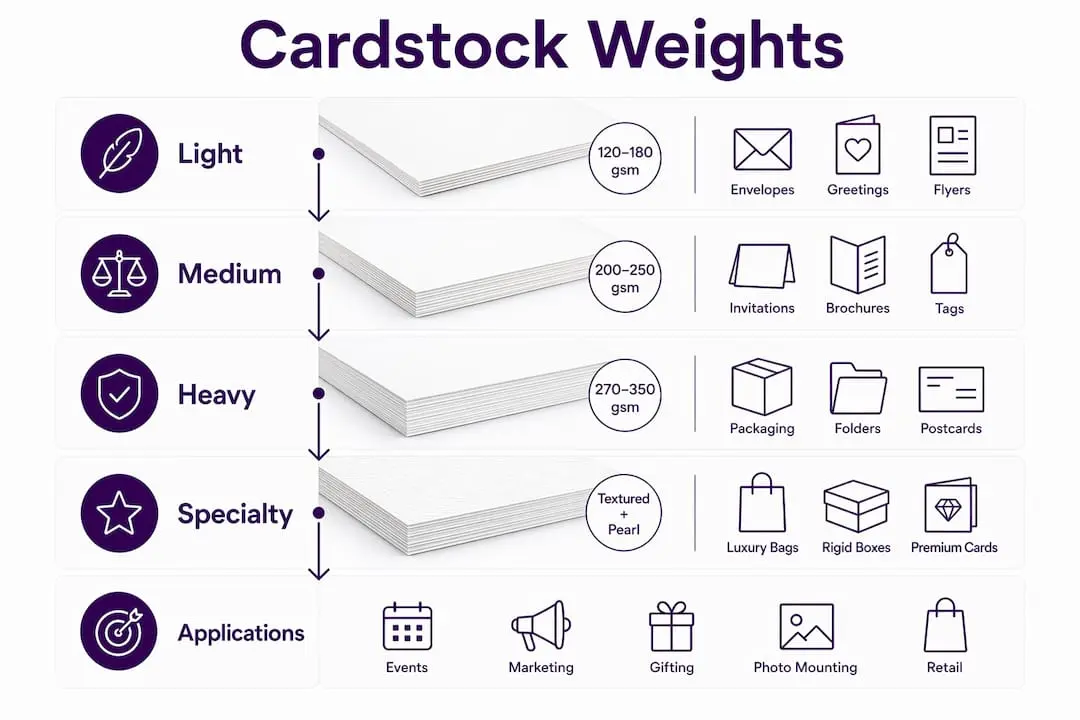
Cardstock generally weighs between 160 and 300 gsm, and that range covers almost every paper crafting need you will encounter. Weight is the single most important variable to understand before you buy. It determines how a sheet cuts, folds, layers, and holds its shape over time.
Light cardstock: 160–176 gsm
Light cardstock, roughly 60–65 lb cover weight in North American terms, is the workhorse of layering and die-cutting. It cuts cleanly on electronic cutting machines and folds without cracking when scored correctly. Use it for decorative mats, background panels, and intricate die-cut shapes that need to sit on top of a heavier base.
Medium cardstock: 176–216 gsm
The 176 gsm mark (65 lb cover) is widely regarded as the most versatile weight for backgrounds and mats. At 216 gsm (80 lb cover), cardstock becomes the standard for card bases. It holds a clean fold, resists buckling under adhesive, and feels substantial in the hand. Most greeting card projects start here.
Heavy cardstock: 216–300 gsm
Heavier 216–300 gsm stock is the industry standard for card bases and 3D structural elements. At this weight, cardstock supports box constructions, layered dimensional projects, and anything that needs to stand upright. The trade-off is that very heavy stock requires more pressure to score and can crack if folded without preparation.
- 160–176 gsm: Layering, die-cuts, decorative panels
- 176–216 gsm: Backgrounds, mats, versatile mid-weight projects
- 216 gsm: Card bases, clean folds, standard greeting cards
- 250–300 gsm: 3D models, boxes, structural elements
Pro Tip: If you are new to cardstock, start with 216 gsm. It is stiff enough to feel professional but forgiving enough to fold, score, and cut without specialist equipment.
How do cardstock surface finishes impact crafting techniques?
The surface finish of cardstock determines how ink sits, how adhesive bonds, and how the finished piece looks under light. Weight tells you how strong a sheet is. Finish tells you what you can do with it.
Smooth cardstock
Smooth cardstock ensures crisp stamping and clear ink blending. Dye inks spread evenly, pigment inks dry with sharp edges, and alcohol markers blend without dragging. If stamping or ink blending is central to your project, smooth cardstock is the correct choice. Any texture, however subtle, can break up a stamped image and reduce its clarity.
Textured cardstock
Textured finishes such as linen, canvas, and woodgrain add tactile depth to a project without any additional embellishment. They work beautifully as background panels and card bases where visual interest matters more than fine-detail printing. The caveat is that textured cardstock can impede fine-detail stamping. Ink sits unevenly across raised fibres, which softens sharp edges on small stamps.
Specialty finishes
Shed-free glitter cardstock is the preferred choice for party decor and event crafts. It cuts cleanly on electronic cutting machines without leaving a trail of loose glitter across your workspace or machine rollers. Glitter cardstock for party decor also holds its sparkle through handling, which standard glitter paper does not.
- Smooth: Stamping, ink blending, alcohol markers, clean printed layers
- Linen/canvas texture: Decorative backgrounds, card bases, rustic aesthetics
- Woodgrain texture: Nature themes, masculine card designs, dimensional panels
- Shed-free glitter: Party decor, event invitations, machine-cut embellishments
- Pearlescent/shimmer: Wedding stationery, elegant cards, layered accents
Pro Tip: Always match your finish to your primary technique before you buy. A beautiful textured sheet is wasted if your project relies on a stamped focal image that needs a smooth surface to read clearly.
What are best practices for choosing and using cardstock?
Choosing cardstock well is a skill that saves you money, time, and frustration. The following practices apply whether you are making a single card or working through a large batch project.
-
Check grain direction before folding. Cardstock has a grain direction determined by how the fibres align during manufacture. Folding with the grain produces a clean, smooth crease. Folding against the grain risks cracking, especially at heavier weights. Scoring perpendicular to the grain with a bone folder before folding is the most reliable way to get a professional result.
-
Choose solid-core cardstock for die-cutting. Solid-core cardstock has consistent colour throughout its thickness. White-core cardstock shows a white edge after cutting, which looks unfinished on intricate shapes. For electronic cutting machines, solid-core is the professional standard.
-
Test before committing to a large project. Two 250 gsm sheets can perform very differently because of differing fibre composition and coatings. Always test your chosen cardstock with the specific ink, adhesive, and cutting tool you plan to use. A five-minute test prevents a ruined batch.
-
Order swatch samples first. Sampling before bulk purchasing saves money and storage space. Colour on a screen rarely matches the physical sheet, and weight descriptions do not convey how a sheet actually handles.
-
Layer weights deliberately. Use a heavy base (216 gsm or above) and layer lighter sheets (160–176 gsm) on top for dimension. This approach gives your project structural strength without the bulk that comes from stacking multiple heavy sheets.
Pro Tip: Apply the Paper Fit Framework when selecting cardstock: define your project type first, then match weight, finish, and core colour to those specific needs. Working backwards from the project prevents impulse purchases that sit unused.
How does cardstock compare to other paper types used in crafting?
Understanding where cardstock sits relative to other papers stops you from reaching for the wrong material and producing a result that disappoints.
Standard printer paper weighs 20–24 lb, which is approximately 75–90 gsm. Printer paper is too thin and prone to buckling when adhesive is applied. It has no structural role in finished paper crafts. A card base made from printer paper feels flimsy and creases at the slightest pressure. For keepsake-quality work, it is simply the wrong tool.
Patterned scrapbook paper typically sits at 60–80 lb text weight, which is lighter than cardstock. It serves a decorative function rather than a structural one. You layer it on top of a cardstock base, not instead of one. Its surface is designed for visual appeal, and it rarely has the stiffness to hold a fold cleanly.
Cardstock is also acid-free and durable, which matters for projects intended to last. Acid in paper causes yellowing and brittleness over time. Acid-free cardstock preserves colour and integrity for years, which is why it is the standard for scrapbooking and handmade cards given as gifts.
| Paper type | Weight range | Primary use | Structural role |
|---|---|---|---|
| Printer paper | 75–90 gsm | Everyday printing | None |
| Text-weight paper | 90–120 gsm | Decorative layers, journalling | Minimal |
| Patterned scrapbook paper | 120–160 gsm | Decorative panels, backgrounds | Low |
| Cardstock | 160–300 gsm | Card bases, 3D elements, die-cuts | High |
| Cardboard | 300 gsm+ | Packaging, heavy construction | Very high |
The table makes the hierarchy clear. Cardstock occupies the middle ground that most paper crafting projects actually need. It is stiff enough to hold form and light enough to cut, fold, and layer without specialist tools.
Creative ways to use different cardstock types for crafting inspiration
The best cardstock craft ideas come from understanding what each weight and finish does well, then building projects around those strengths rather than fighting against them.
-
Intricate die-cuts: Use 160–176 gsm smooth cardstock for detailed shapes cut on an electronic cutting machine. The lighter weight reduces drag on the blade and produces cleaner edges on fine details such as lace borders and botanical outlines.
-
Sturdy card bases: A 216 gsm solid-core sheet gives a greeting card the weight and feel of a professionally printed product. Pair it with a contrasting smooth layer at 176 gsm for a classic double-panel construction.
-
3D boxes and models: Heavy cardstock at 250–300 gsm holds its shape when scored and folded into three-dimensional forms. Gift boxes, advent calendar pockets, and paper lanterns all benefit from this weight range.
-
Textured backgrounds: Linen-finish cardstock at 216 gsm creates a background panel that looks layered and considered without any additional embellishment. It works particularly well in masculine card designs and nature-themed layouts.
-
Event decor and party crafts: Shed-free glitter cardstock at 160–176 gsm cuts cleanly into banners, cake toppers, and table decorations. Because it does not shed, it is safe to use around food and on surfaces where loose glitter would be a problem.
-
Dimensional layering: Combine a 300 gsm base with 176 gsm mid-layers and 160 gsm top details to build genuine depth into a project. Foam pads between layers add further dimension without adding significant weight.
Handmade paper crafting techniques often rely on this kind of layered approach. The key is treating each weight as a specific tool rather than a generic substitute for any other.
Key takeaways
Cardstock is the single material that determines whether a paper craft project holds its shape, takes ink cleanly, and lasts over time.
| Point | Details |
|---|---|
| Weight drives structure | Use 216 gsm or above for card bases and 3D elements; lighter weights suit layering and die-cuts. |
| Finish determines technique | Match smooth cardstock to stamping and ink blending; use textured finishes for decorative backgrounds. |
| Solid-core matters for cutting | Solid-core cardstock produces clean, coloured edges on die-cuts; white-core shows an unfinished white edge. |
| Test before large projects | Fibre composition and coatings vary between sheets of the same weight, so always test with your actual inks and adhesives. |
| Acid-free extends project life | Acid-free cardstock resists yellowing and brittleness, making it the correct choice for keepsake cards and scrapbook layouts. |
Why cardstock choices matter more than most crafters realise
The most common mistake I see from crafters at every level is treating cardstock as a generic category. They pick up whatever is on offer, assume 200 gsm is 200 gsm, and then wonder why their stamped images look muddy or their card bases crack along the fold. The material is not the problem. The mismatch is.
What changed my own practice was accepting that testing cardstock before a project is not a luxury step. It is the step. Two sheets with identical weight labels can behave completely differently under the same ink or adhesive because of how they were manufactured. Once you accept that, you stop blaming your tools and start making better decisions.
My honest recommendation for anyone building a cardstock stash is to start narrow. Buy one reliable 216 gsm smooth sheet in a core colour range, one 176 gsm smooth in white and ivory, and one textured option in a neutral. Master those before adding specialty finishes. The crafters who produce the most consistent results are not the ones with the largest stash. They are the ones who know exactly how their materials behave.
Budget is a real consideration, and I will not pretend otherwise. But paper crafting tips for 2026 consistently point to the same conclusion: buying a small swatch pack from a quality supplier costs far less than a bulk order of cardstock that turns out to be wrong for your projects.
— Rob
Cardstock supplies and printable projects at Craftsuprint
Craftsuprint brings together a curated selection of craft supplies, downloadable templates, and printable projects designed specifically for paper crafters who want results they can be proud of.
Whether you are looking for card-making kits that specify the exact cardstock weight to use, or printable die-cut sheets sized for standard cardstock formats, Craftsuprint’s craft supplies catalogue covers the full range. Members also get access to exclusive downloads, weekly freebies, and the Create and Craft Members Gift offer, which is a practical starting point if you want quality materials without committing to a large upfront spend. The platform is built for hobbyists who take their craft seriously.
FAQ
What weight of cardstock is best for greeting cards?
The industry standard for greeting card bases is 216 gsm (80 lb cover weight). This weight holds a clean fold, resists buckling under adhesive, and feels substantial without being difficult to cut or score.
What is cardstock used for in paper crafts?
Cardstock is used for card bases, 3D models, die-cut shapes, scrapbook layouts, decorative backgrounds, and event decor. Its weight range of 160–300 gsm makes it the most versatile paper type in hobby crafting.
Does cardstock need to be acid-free?
Acid-free cardstock is the correct choice for any project intended to last. Acid in paper causes yellowing and brittleness over time, which degrades both the colour and the structure of finished work.
What is the difference between smooth and textured cardstock?
Smooth cardstock produces crisp stamped images and clean ink blending. Textured cardstock adds visual and tactile depth but can soften fine-detail stamping because ink sits unevenly across raised fibres.
How do I stop cardstock from cracking when I fold it?
Score the fold line with a bone folder before folding, and always fold with the grain direction rather than against it. If cracking persists, reduce the cardstock weight or switch to a stock specifically designed for folding.