
Scoring Boards for Cards: 3 Standouts and a Safe DIY Option
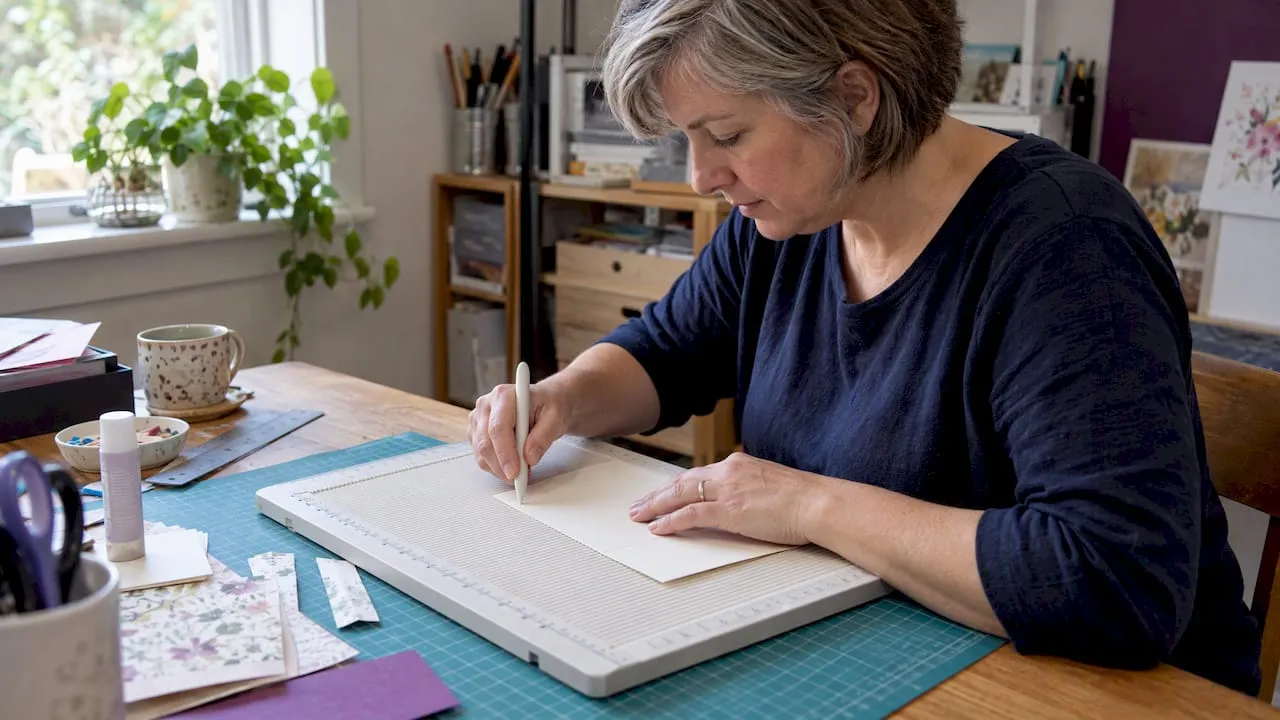
For most card-making hobbyists, the Crafter’s Companion Master Creator Scoreboard is considered a good option for balancing grooves, accessories and price, while the Hunkydory The Adorable Scoreboard Mini with Scoring Tool suits small-space crafters and the Crafter’s Companion The Ultimate Pro suits those producing multiples or boxes. All three are widely stocked across craft retailers and major marketplaces, so availability shouldn’t hold you back.
TL;DR:
- A6 blanks fit most boards, while A5 and A4 sheets need a full size working edge to avoid repositioning paper and risking crooked creases.
- Grooves spaced one eighth of an inch apart suit detailed folds, while quarter inch spacing handles basic cards; check the board’s measurement units.
- Cardstock around 300gsm or heavier often folds more cleanly after two light scoring passes, since one hard pass can crack its surface.
- Align paper to the reference edge, score twice in the same groove, then smooth the crease with a bone folder; never use a blade.
Table of Contents
- Scoring board shortlist and how they compare
- How to choose the right scoring board for your projects
- Getting crisp folds: technique and a simple DIY board
- What craft experts say about scoring boards
- Keeping your scoring board in good condition
- Matching your board to different paper weights and materials
- Scoring boards versus standalone scoring styluses
- Pairing your scoring board with Craftsuprint downloads
- Scoring board sizes against common card formats
- What buyers and designers look for before purchasing
- A fair verdict on buying a scoring board
- Craftsuprint’s take on scoring and printable templates
- Browse templates and supplies to match your new board
- FAQ
- Sources
Scoring board shortlist and how they compare
Each of these boards solves a slightly different problem, from tight storage to multi-panel folding. A scoring board with evenly spaced grooves and a stylus gives the most accurate and repeatable results for parallel scores on boxes and multi-panel cards, which is why repeatability shows up again and again as the reason hobbyists upgrade from ad-hoc scoring methods.
| Board | Board size / working area | Groove spacing | Included accessories | Best for | Price band |
|---|---|---|---|---|---|
| Crafter’s Companion Master Creator Scoreboard | Full-size multi-groove board | Multiple increments for varied folds | Scoring stylus, measurement markers | Frequent crafters making varied projects | Mid |
| Hunkydory The Adorable Scoreboard (Classic Cream Edition) | Card-sized working area | Standard groove set | Themed cream finish | Hobby crafters wanting a branded, craft-shop board | Entry to mid |
| Hunkydory The Adorable Scoreboard Mini with Scoring Tool | Compact mini footprint | Close-set grooves for small cards | Included stylus | Limited space or small card projects | Entry |
| Sizzix Making Tool - Scoring Board & Trimmer - Royal Fuchsia | Combined scoring and trimming surface | Standard groove set | Integrated trimmer | Cutting and scoring in one tool | Mid |
| Spellbinders 12" x 12" Scoring Board | Full 12" x 12" surface | Standard groove set | None listed | Scrapbookers and larger sheet projects | Mid |
| Crafter’s Companion The Ultimate Pro | Large multi-function board | Fine increments for multiples | Stylus plus extra functions | Advanced hobbyists producing multiples | Premium |
| Crafter’s Companion The Enveloper Pro Scoreboard | Board plus envelope templates | Envelope-specific spacing | Envelope guides and stylus | Makers who build custom envelopes regularly | Mid to premium |
| Crafter’s Companion Top Score Multiboard Scoreboard | Multi-format working area | Several measurement options | Multiple markers | Crafters wanting one board for several craft types | Mid |
| Crafter’s Companion Enveloplus | Envelope-focused surface | Envelope template spacing | Envelope-making tools | Specialist envelope makers | Mid |
| Crafter’s Companion Envelobox Creator | Combined envelope and box surface | Box and envelope spacing | Box and envelope guides | Makers who also build gift boxes | Mid to premium |
| Crafter’s Companion The Boxer | Box-focused working area | Box-panel spacing | Scoring guides | Crafters who make gift boxes alongside cards | Mid |
A few buying notes worth knowing before you browse:
- Craft retailers, department stores and major marketplaces such as Amazon consistently stock the same family of boards, so price comparison across a few sites usually pays off.
- Entry-level boards usually cover standard card sizes, while multi-function boards often include envelope or box templates at a higher price point.
- Accessories such as a stylus or bone folder, when bundled, can reduce additional purchases needed.
How to choose the right scoring board for your projects
Start with the size of card you make most often. A board with a working area that comfortably fits A6 or A5 card blanks handles most greetings cards, while anyone cutting from A4 or 12" x 12" sheets needs the larger working surface a full-size board provides.
Groove spacing matters more than it first appears. Boards marked in eighth-inch increments suit finer, more frequent folds, while quarter-inch spacing is enough for simple single-fold cards. Check which units the board displays, since metric and imperial markings aren’t always both present.
Included extras change how much you spend afterwards. A stylus, scoring markers or envelope templates bundled with the board save you buying them separately, and envelope-specific guides are worth seeking out if you make your own envelopes often.
Durability and storage matter for a hobby tool you’ll use repeatedly. A rigid, flat board that stores upright or in a drawer without warping will outlast a thinner one left flat under other supplies.
Pro Tip: Lay a scoring board flat rather than leaning it against a wall for long periods, since gravity can gradually warp lighter plastic boards.
Before buying, run through a short checklist:
- Does the board cover your most common card size comfortably?
- Are the grooves spaced to suit the folds you make most?
- Does it include a stylus or will you need to buy one separately?
- What’s the returns policy if the measurements don’t suit your projects?
- Is there a warranty against warping or cracking?
- Are both metric and imperial markings shown, if you need both?
Getting crisp folds: technique and a simple DIY board
Good scoring technique matters as much as the board you choose. Score before you fold, finish with a bone folder, and always avoid sharp blades for scoring, since a cut weakens rather than strengthens the fold.
- Align your card against the board’s reference edge rather than measuring from whichever edge is nearest.
- Score with a light first pass, then a firmer second pass along the same groove.
- Finish by running a bone folder along the crease to flatten and smooth it.
- For multi-panel folds, keep working from that same reference edge and measure once rather than re-measuring between each score line, since errors compound across panels.
If you don’t have a board to hand, a temporary one is simple to build. You’ll need a ruler, a sheet of craft foam or a foam mat, and a blunt stylus or dried-up ballpoint pen.
- Lay the foam mat flat on your work surface.
- Place the ruler along your marked fold line.
- Run the blunt stylus firmly along the ruler’s edge to indent the paper.
- Fold along the indent and finish with a bone folder.
What craft experts say about scoring boards
Craft bloggers who test scoring tools consistently point to the same advantage: a dedicated scoring board with measurement markers speeds up repetitive scoring and removes the guesswork of lining up a ruler by eye each time.
A scoring board with evenly spaced grooves and a stylus is widely regarded as an accurate and repeatable method for parallel scores on boxes and multi-panel cards.
This repeatability is especially helpful when producing multiple items like invitations, boxes, or folded envelopes. Each of those tasks punishes small measuring errors far more than a single folded card does.
Keeping your scoring board in good condition
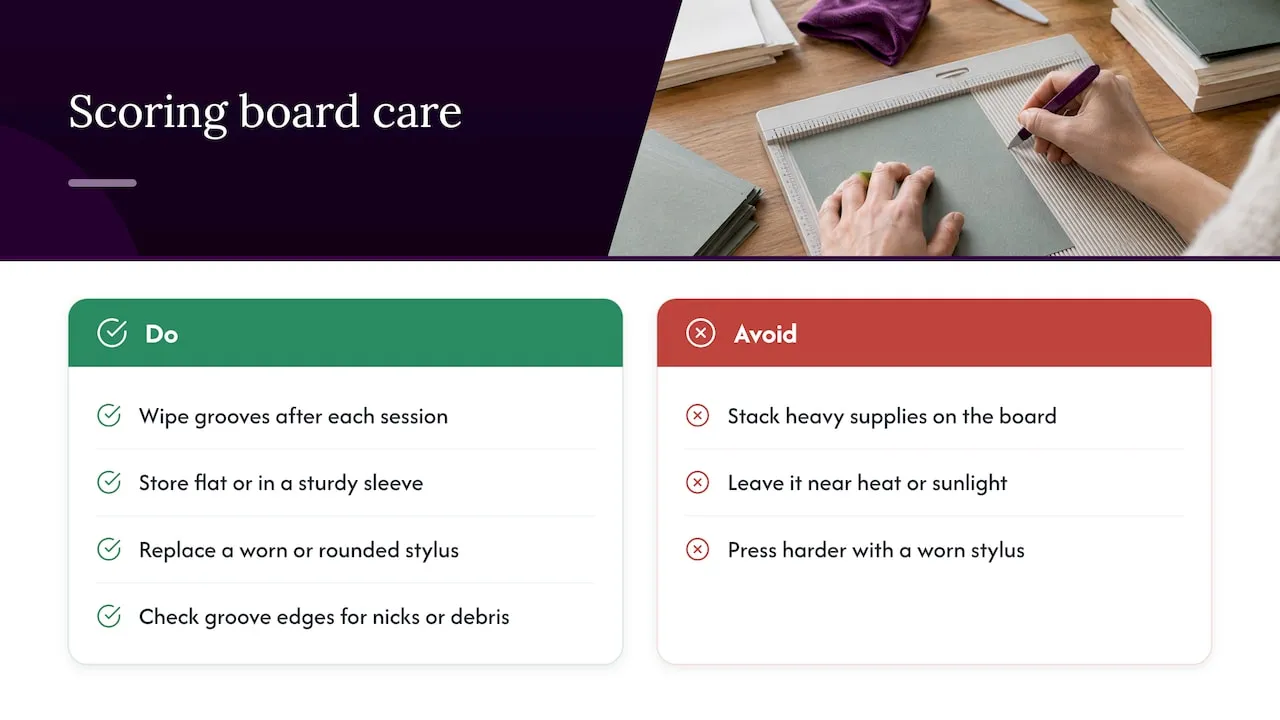
A scoring board is a simple tool, but a few habits keep it accurate for years. Wipe the grooves clean after each session, since paper dust and adhesive residue build up in the channels and make the stylus drag unevenly.
Store the board flat, or upright in a sturdy sleeve, rather than stacking heavy supplies on top of it. Pressure over time can flatten or warp the grooves on lighter plastic boards, which throws off the crispness of your folds.
Avoid leaving a board near direct heat or a sunny windowsill, since plastic components can warp in warm conditions. If your stylus tip wears down or rounds off, replace it rather than pressing harder, since extra pressure on a worn tip tends to tear rather than crease delicate cardstock.
Check the groove edges occasionally for nicks or debris buildup that could mark your paper. A quick wipe with a soft, dry cloth after each project is usually enough to keep a board performing as it did when new.
Matching your board to different paper weights and materials
Most scoring boards handle standard cardstock weights without issue, but thicker or coated stock needs a firmer, more deliberate pass. Heavier cardstock, around 300gsm and above, often benefits from two lighter score passes rather than one heavy one, since a single hard pass can crack the surface rather than crease it cleanly.
Lightweight paper scores easily but can tear if you press too hard with a sharp stylus tip, so a rounded or ball-tip stylus is gentler on delicate sheets. Textured or embossed cardstock sometimes hides the scored line, so a slightly deeper groove helps the fold register clearly.
Metallic and pearlescent papers can show stylus marks beyond the fold line if you’re not precise, so aligning carefully to the board’s reference edge matters more on these finishes than on plain matte card.
Scoring boards versus standalone scoring styluses
A standalone scoring stylus without a board gives you flexibility for irregular shapes and odd angles that a fixed-groove board can’t handle. It relies entirely on your own ruler placement and a steady hand, which makes it harder to repeat an identical fold across multiple cards.
A board’s fixed grooves and measurement markers remove that guesswork, which is why repeatability is the main reason hobbyists upgrade from a ruler-and-stylus combination to a dedicated board once they’re making more than the occasional card.
That said, a stylus alone remains useful as a lightweight backup for travel, for one-off angled folds, or for touch-up scores on a project already underway. Many hobbyists end up owning both: a board for standard, repeated work and a loose stylus for anything a groove can’t accommodate.
Pairing your scoring board with Craftsuprint downloads
Once you’ve got a board that produces clean, consistent folds, the next step is choosing projects that put it to good use. Our printable folded card templates are designed around standard fold lines, so they’re a straightforward way to test a new board’s groove spacing against a real project.
Gatefold designs are a particularly good match, since they rely on two parallel folds meeting a central panel evenly. Browsing gatefold card templates gives you a ready-made project to check how your board handles symmetrical scoring. For readers exploring fold styles beyond the basics, our piece on creative card folding styles covers swing cards, panel sets and other formats where accurate scoring makes a visible difference to the finished card.
Scoring board sizes against common card formats
Matching board size to the paper format you cut from most often avoids unnecessary re-measuring. A6 card blanks, the standard greetings card size, fit comfortably on almost any board, including the mini options designed for small projects.
A5 and A4 sheets need a board with a longer working edge, since folding a long score line on a short board means repositioning the paper partway through, which risks a crooked crease. Full-size boards, including 12" x 12" options, are built for scrapbook paper and larger single sheets, letting you score the full width in one pass.
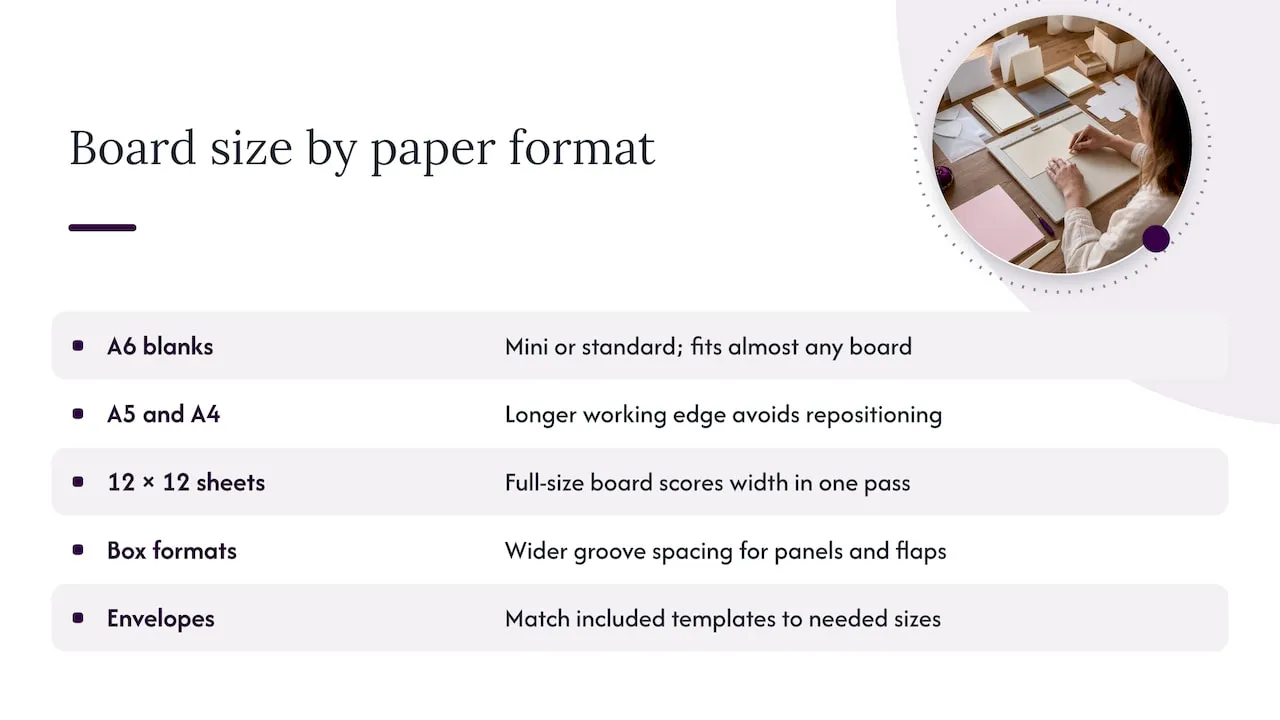
Box-making formats, such as those made on the Crafter’s Companion The Boxer or the Crafter’s Companion Envelobox Creator, need boards with wider spacing between parallel grooves to accommodate box panels and flaps, which sit further apart than typical card folds. Envelope-focused boards, including the Crafter’s Companion Enveloplus and the Crafter’s Companion The Enveloper Pro Scoreboard, are built around standard envelope template sizes rather than card dimensions, so check the template sizes included match the envelope sizes you actually need.
What buyers and designers look for before purchasing
Shoppers comparing scoring boards tend to weigh the same handful of factors: how clear the measurement markings are, whether a stylus is included, and how sturdy the board feels in regular use. Retail listings across craft shops and marketplaces such as Amazon repeatedly show buyers calling out accessories and measurement clarity as the details that matter most when choosing between similar boards.
Designers who work with folded formats regularly tend to favour boards with finer groove spacing for intricate multi-panel projects, and reserve simpler, wider-groove boards for single-fold cards where precision matters less. If you’re new to scoring, reading a handful of recent reviews on the specific board you’re considering, rather than relying on the product description alone, usually surfaces any quirks with groove depth or stylus comfort before you commit.
A fair verdict on buying a scoring board
The scoring board market rewards buyers who think about frequency, not just features. A hobbyist who makes a handful of cards a month doesn’t need the same board as someone mass-producing wedding stationery or building boxes weekly, yet most buying guides treat every board as if it serves every crafter equally.
My honest view is that the groove spacing matters more than any bundled extra. A board with the right increments for your typical fold count will outperform a feature-heavy board with mismatched spacing, no matter how many accessories come in the box. Buyers also underestimate how much the stylus itself affects results: a worn or overly sharp tip can undo the benefit of an otherwise excellent board.
If there’s one thing worth changing about how people shop for these, it’s spending less time comparing brand names and more time matching groove spacing to the actual folds you make.
— Rob
Craftsuprint’s take on scoring and printable templates
We built Craftsuprint around digital craft downloads, from card making kits to paper patterns, so a well-scored card is only half the project. Once your folds are crisp, a printable template gives the fold somewhere to do its job properly.
Swing cards, gatefolds and multi-panel sets all rely on the same precise, repeatable creases a good scoring board produces. Our card folding styles guide walks through which fold types suit which templates, and our paper crafting tips for 2026 covers broader technique alongside design choices.
Browse templates and supplies to match your new board
Once your scoring board is sorted, pairing it with the right printable design makes the difference between a tidy fold and a finished card worth sending. We offer a variety of downloadable templates and supplies designed for folded formats.
Worth browsing while your board is out:
- Card Making for printable kits and fold-ready templates
- Paper Craft for broader paper-based project downloads
- Craft Supplies for accessories like bone folders and cardstock
A gatefold or multi-panel template is a good first project to try against your new board, since it puts the groove spacing to a real test straight away. Head over to our Card Making category to find a design worth folding today.
FAQ
What is the best scoring board for card making?
The Crafter’s Companion Master Creator Scoreboard suits most hobbyists thanks to its varied groove spacing and included stylus, while the Hunkydory The Adorable Scoreboard Mini with Scoring Tool is a better fit for small-space crafters. Your best choice depends mainly on the card sizes and fold types you make most often.
What is a good scoring tool for cardstock?
A board with evenly spaced grooves paired with a stylus is the most reliable combination for cardstock, since it keeps every fold aligned to the same reference edge. For heavier cardstock, a rounded stylus tip and two light passes work better than one heavy pass.
What is the best scoring tool?
A dedicated scoring board with a bundled stylus outperforms a loose stylus alone for repeated or multi-panel folds, since the fixed grooves remove the need to re-measure each line. A standalone stylus still has a place for one-off angled folds a board’s grooves can’t reach.
How do you score cardstock without a scoring tool?
You can score cardstock with a ruler, a blunt stylus or dried-up ballpoint pen, and a foam mat underneath to cushion the indent. Finish the crease with a bone folder, and always avoid using a sharp blade to score, since a cut weakens rather than strengthens the fold.
Sources
- Scoring and folding: how to get clean, crack-free creases – PaperFrost
- Simply Scored scoring tool – for crisp folds and clever creations | Pootles
- How to cut and score paper like a pro – Kristy Coromandel