
Decades or Years: Pigment or Dye Ink for Photo & Craft (7–8 vs 2–4)
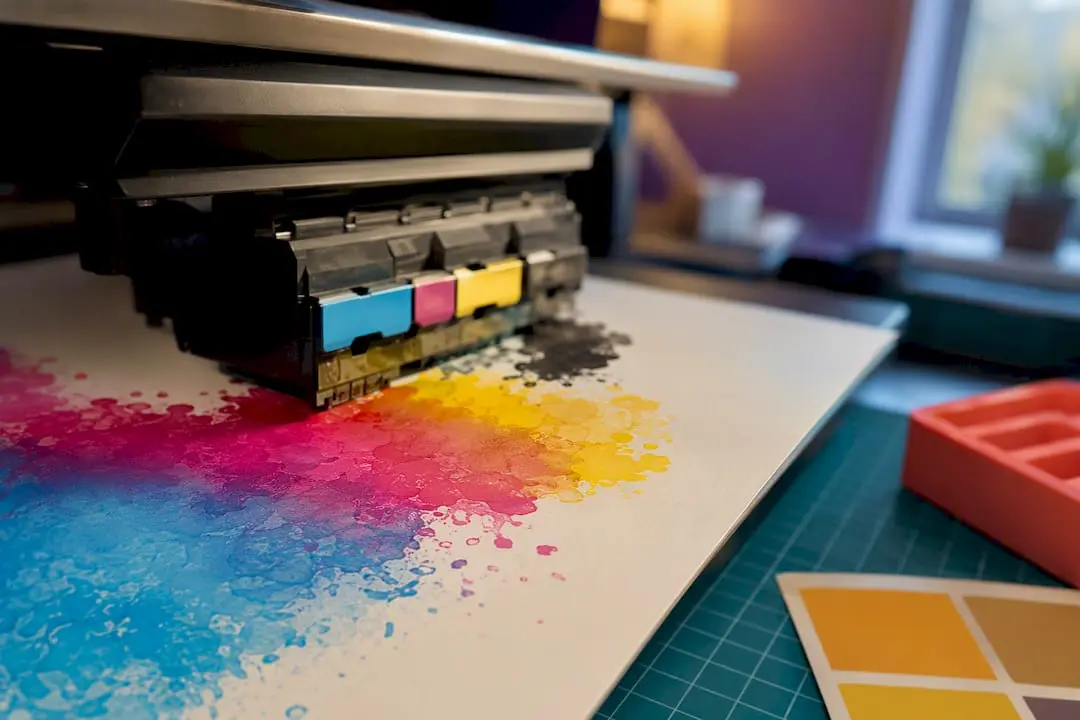
For long-lasting, archival prints, choose pigment ink. For the most vivid, glossy photo reproduction, choose dye ink. The trade-off is straightforward: pigment gives you water resistance and decades of fade resistance, while dye gives you brighter colour and faster drying on coated paper. Always match your ink to whatever chemistry your printer was built for.
TL;DR:
- Pigment ink offers superior fade resistance and water resistance, making it ideal for long-lasting and archival prints.
- Dye ink provides brighter colors and faster drying, especially on coated gloss paper, but fades quicker when exposed to light and moisture.
- Switching between pigment and dye ink in the same printer is unsafe because of incompatible hardware designed for specific ink chemistries.
- For high-fidelity photo printing on glossy stock, dye ink yields the most vivid colors, while pigment ink is better suited for fine art and keepsake projects.
- Testing ink and paper combinations before a full print run helps ensure color accuracy and longevity, especially when using different paper textures.
Table of Contents
- Pigment vs dye ink: what’s actually different at a molecular level
- Dye ink advantages and disadvantages
- Pigment ink advantages and disadvantages
- Which ink suits your project? A quick decision guide
- Can you swap pigment and dye ink in the same printer?
- What lab testing shows about fade resistance
- Practical printing tips for crafters and printable projects
- The one line to remember
- Why the pigment vs dye debate misses the real question
- Sources
- FAQ
Pigment vs dye ink: what’s actually different at a molecular level
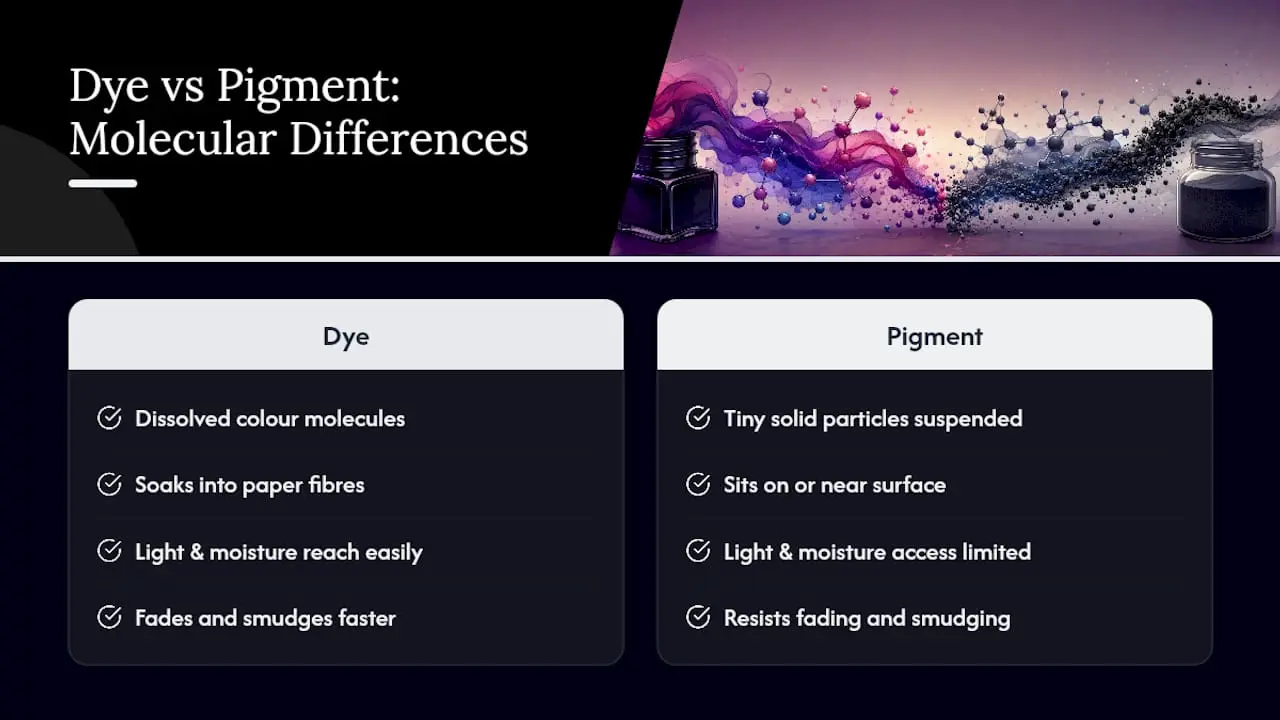
The whole pigment vs dye ink debate comes down to how each substance behaves once it leaves the print head. Dye ink is made of colour molecules that fully dissolve into the carrier liquid, the same way sugar disappears into tea. Pigment ink, by contrast, is made of tiny solid particles suspended in the liquid rather than dissolved in it, so it never truly merges with the fluid it travels in.
That distinction explains almost everything else in this comparison. Dissolved dye molecules soak into paper fibres, which lets light and moisture reach them easily and accelerates fading and smudging. Pigment particles sit on or near the paper surface instead, forming a thin physical layer that resists both. Pigments must be dispersed and stabilised using surfactants and surface treatments, and the quality of that dispersion directly affects colour strength and print durability.
Modern formulations have blurred some old assumptions. Today’s dyes resist fading better than the dyes of a decade ago, and today’s pigments lay down richer colour on glossy stock than earlier pigment cartridges managed. The gap has narrowed. It hasn’t closed.
Dye ink advantages and disadvantages
Dye ink earns its popularity through sheer visual punch. Dye-based inks typically produce brighter, more saturated colours on coated gloss papers, which is why most consumer photo printers still ship with dye cartridges as standard.
- Vivid, highly saturated colour with smooth gradients, particularly noticeable in skin tones and sunsets
- Excellent performance on glossy and coated papers, where the ink sits closer to the surface and reflects light cleanly
- Lower cost per cartridge and wider availability across entry-level printers
- Weaker lightfastness, meaning colours shift and fade faster under UV exposure
- Water sensitivity: a single splash or a damp finger can smear text or bleed colour
- Shorter realistic display life for anything left unframed in direct light
For a birthday photo printed today and stuck on the fridge, none of that matters much. For a print you want your grandchildren to see, it does.
Pigment ink advantages and disadvantages
Pigment ink trades a little sparkle for permanence, and for anything meant to last, that’s usually the right trade.
- Superior lightfastness, holding colour and contrast far longer under normal display conditions
- Genuine water resistance, so a spilt drink or damp hands won’t wreck the print
- Crisper text and line work, since particles sit on the surface rather than feathering into fibres
- Slightly muted saturation on high-gloss paper, where the particle structure scatters light rather than transmitting it
- Higher ink cost per millilitre than most dye cartridges
- Slower drying or settling on some glossy media, occasionally leaving a faint sheen difference known as bronzing
Black-and-white photography, gallery-quality fine art reproductions, and keepsake cards meant to survive years in a drawer all lean on pigment’s strengths. Craft communities favour pigment ink specifically for heat embossing and wet-handling techniques, because it stays put on the surface long enough to take embossing powder or resist smudging during assembly.
Which ink suits your project? A quick decision guide
Matching ink to project is less about personal preference and more about what the paper and end use demand.
- Glossy colour photographs for framing or albums — dye ink, printed on coated gloss stock, gives the punchiest colour and the smoothest tonal transitions.
- Framed fine art or prints destined for long display — pigment ink on matte or fine art paper, ideally behind UV-filter glazing.
- Greeting cards and keepsake craft projects — pigment ink, since cards get handled, occasionally get damp, and often get kept.
- Stickers and adhesive labels — pigment ink resists smudging during application and handling, particularly on sticker and small decorative stock.
- Mixed media crafts involving glue, water washes or embossing — pigment ink, because it won’t lift or bleed when wet techniques are layered on top.
- High-volume everyday printing on a budget — dye ink, which remains cheaper per page and dries faster for quick turnaround.
Paper matters as much as ink chemistry. Glossy coated stock flatters dye. Matte, textured, and heavyweight cardstock generally suit pigment better, since the surface doesn’t rely on light reflecting cleanly off a coating.
Can you swap pigment and dye ink in the same printer?
No, not safely. Printers are engineered around one ink chemistry, with nozzle sizes, heating elements, and internal tubing calibrated for either dissolved dye or suspended pigment particles. Fitting an unsupported ink type into a printer built for the other can clog nozzles and damage the print head, sometimes permanently.
Pigment’s larger, suspended particles need wider nozzle tolerances and different flushing routines than the fully dissolved molecules in dye ink. Force the wrong chemistry through the wrong hardware and you risk a printhead replacement, plus a voided warranty. Check your printer’s manual, the markings printed on your existing cartridges, or your retailer’s specification sheet before buying replacement ink. It takes two minutes and saves a repair bill.
What lab testing shows about fade resistance
The lightfastness gap between the two ink types is well documented and larger than most casual buyers expect. Pigment-based prints commonly score around 7 to 8 on the Blue Wool Scale, while dye-based prints often score between 2 and 4, a lab measure of how much light exposure a coloured material can withstand before visibly fading.
Blue Wool Scale readings translate directly into real display expectations: a rating of 7 to 8 suggests decades of stable colour under normal indoor light, while a rating of 2 to 4 can mean noticeable fading within a few years of unprotected display.
Those numbers assume a specific ink, paper, and exposure combination, though, and results shift with framing choices. Pairing pigment ink with archival, acid-free paper and UV-filter glazing gets you closest to the lab’s best-case figures. Keep any print, pigment or dye, out of direct sunlight, and frame anything you care about behind glass rated to filter ultraviolet light.
Practical printing tips for crafters and printable projects
Before committing to a full print run of any printable design, run a small test strip on the exact paper stock you intend to use. Ink behaves differently on matte cardstock than it does on glossy photo paper, and a five-minute test saves an afternoon of wasted supplies.
- Choose pigment ink for cards, tags, and keepsakes that will be handled, stamped, or embossed
- Choose dye ink for vivid one-off photo prints where archival life matters less
- Allow extra drying time on coated stock before adding embellishments or laminating
- Store finished prints flat, away from direct sunlight and humidity, to slow fading regardless of ink type
Craftsuprint’s guide to printable crafting workflows walks through drying and finishing steps in more detail, and the craft supplies range covers laminates and fixatives worth pairing with either ink type.
Pro Tip: Print a small colour swatch on your actual project paper before running a full batch. Glossy and matte stock can shift the same design’s colour balance more than switching between dye and pigment ever will.
The one line to remember
Pick pigment for anything that needs to last, and dye for anything that needs to pop. Test your exact paper first, and never fit ink your printer wasn’t built to run.
Why the pigment vs dye debate misses the real question
Most guides frame pigment vs dye ink as a permanent allegiance, as though picking one closes the door on the other. That’s the wrong lens. The evidence points to a much simpler rule: match the ink to the job, not to a general preference, and revisit that choice every time the project changes.
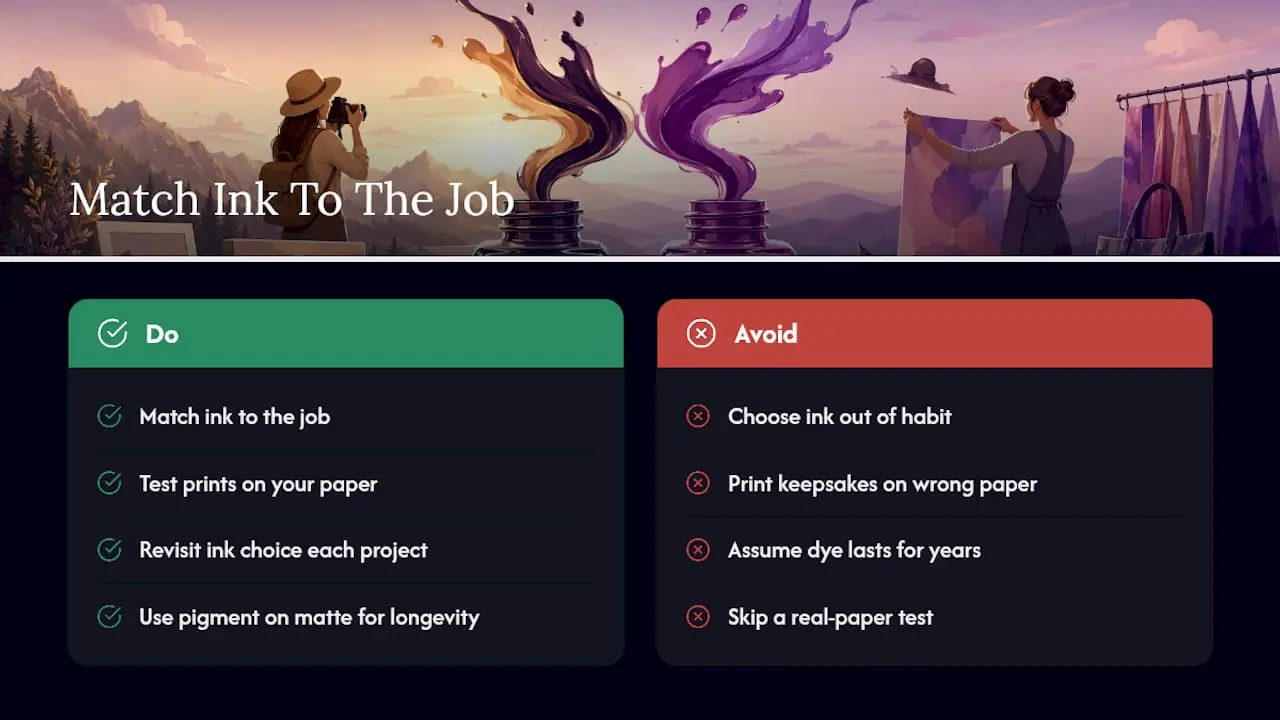
Where conventional advice falls short is treating “vibrancy” and “durability” as a spectrum where you accept mediocrity in one to gain the other. Modern pigment inks on the right matte stock look genuinely striking, not merely “good enough.” The failures I see most often trace back to paper mismatches rather than ink mismatches, printing a keepsake card on glossy stock, or pushing a fine art reproduction through dye cartridges because that’s what came pre-installed.
If you print occasionally and care about a handful of pieces surviving years rather than months, pigment deserves more attention than most buying guides give it. Test on your actual paper before assuming either ink will underperform. That single habit solves more disappointment than any spec sheet comparison ever will.
— Rob
Sources
- Preservation Self-Assessment Program (Digital print permanence guidance)
- Pigments for inkjet applications (Cabot Corporation whitepaper)
- Pigment vs dye ink: What’s the difference? (Adorama ALC)
FAQ
Is pigment or dye-based ink better overall?
Neither is universally better. Pigment wins on longevity and water resistance; dye wins on colour vibrancy and cost, so the right answer depends entirely on the project.
What are the main disadvantages of pigment ink?
Pigment ink can look slightly less saturated on glossy paper, costs more per cartridge, and sometimes dries or settles more slowly on certain glossy media.
Can I put pigment ink into a printer designed for dye ink?
No. Printers are built around one ink chemistry, and forcing the wrong type through unsupported hardware can clog nozzles, damage the printhead, and void your warranty.
How can I tell if my printer uses dye or pigment ink?
Check the printer manual, the labelling on your existing cartridges, or the manufacturer’s specification page. Most consumer photo printers use dye, while many professional and archival printers use pigment.