
8 Field Craft Listing SEO Checklist for Makers That Gets You Found

Craft listing SEO means matching the exact words buyers type into search boxes, so your title, tags and photos surface before your listing even gets clicked. If you only fix one thing today, fix the title: put the buyer’s phrase first, swap the hero photo for one that shows the item in use, and add a long-tail tag you haven’t used before. Everything else in this guide sharpens that same idea across every field.
TL;DR:
- Filling every attribute and category field with accurate, specific information boosts visibility in filtered search results.
- Using long-tail, buyer-focused keyword phrases in titles, tags, and descriptions increases the likelihood of matching high-converting searches.
- Clear, thumbnail-readable hero images and properly named, optimized photos improve click-through rates and search indexing.
- Tracking key metrics such as impressions and click-through rate over time helps confirm which SEO adjustments are effective.
- Prioritizing optimization of high-impact fields like category, attributes, and title yields the best results for increasing visibility and sales.
Table of Contents
- The 8-field craft listing SEO audit checklist
- How do you find the right keywords for craft listings?
- Writing titles, tags and attributes that match how buyers search
- What makes a craft listing’s photos work for SEO?
- How do you write a description that ranks and converts?
- Why does data consistency matter across your whole shop?
- Which metrics actually show your SEO changes are working?
- What SEO mistakes do craft sellers make most often?
- How Craftsuprint models good listing practice for makers
- Why niche focus and documented process matter more than volume
- Speed up your listing work with Craftsuprint’s resources
- Sources
- FAQ
The 8-field craft listing SEO audit checklist
Run this over any listing before you hit publish, or on your best-seller if it’s stalled. Marketplace search engines match buyer queries directly against your title, tags, attributes and category, so those fields carry more weight than a well-written paragraph buried at the bottom of a description, according to Listadum’s guide to listing optimisation.
- Title: buyer phrase first, product type second, then a distinguishing detail (colour, size, occasion). Front-load the words people actually search, not the words you’d use to describe your own work.
- Primary image: shows the whole product on a plain or contextual background, readable as a thumbnail at postage-stamp size.
- Tags and attributes: fill every slot the platform gives you. Empty attribute fields are invisible to filtered search.
- First two description lines: state what it is and who it’s for. These lines often get pulled into search snippets.
- Category: pick the most specific subcategory available, not the closest broad match.
- Pricing and shipping: make sure they’re consistent with similar listings in your niche so you don’t get filtered out of a buyer’s price range unintentionally.
- Processing time and customisation notes: state clearly, since many buyers filter by turnaround time.
- Measurement plan: note today’s views, favourites and conversion rate somewhere before you change anything, so you have a baseline.
None of this takes long once it’s a habit. The value is in doing all eight, not picking your favourite three. A listing with a gorgeous photo and an empty attributes panel still loses to a plainer listing that filled every field, because the second one shows up in more filtered searches.
How do you find the right keywords for craft listings?
Start where your buyers start: the search bar. Type a broad term like “personalised card topper” into a marketplace search box and watch the autocomplete suggestions. Those are real, high-frequency queries other shoppers have typed, not guesses.
- Mine autocomplete first. Type single words and watch what the platform suggests as you add letters. Do the same on Google, since buyers often search there before landing on a marketplace.
- Check the “sold” filter. Search your product type, filter to items already sold, and read the titles and tags of listings that are clearly moving. This tells you which phrasing converts, not just which phrasing ranks.
- Use reverse image search sparingly. Upload a competitor’s hero photo to see how it’s indexed and what alt text or surrounding text search engines associate with it.
- Balance three factors for every phrase: search volume, competition, and relevance to what you actually make. A high-volume phrase that only loosely matches your product will earn clicks and then bounce.
- Favour long-tail, buyer-intent phrases over generic ones. “Watercolour wedding invitation template” beats “wedding invitation” because it matches fewer listings and a more specific buyer.
- Log everything in a simple sheet. One column for the keyword, one for which listing it’s mapped to, one for the date you last tested it. Without this, you’ll forget what you changed and why.
Small shops have a real advantage here. A handmade-focused SEO analysis points out that a narrow, well-documented niche can outrank bigger sellers precisely because larger shops chase broad terms and leave long-tail phrases uncontested.
Pro Tip: Search your own product name plus the word “dupe” or “alternative to”. Buyers hunting for a cheaper or handmade version of a mass-market item use phrasing you’d never think to target otherwise.
Writing titles, tags and attributes that match how buyers search
The first 40 characters of your title matter most, because that’s roughly what shows in search results and thumbnails before the text gets cut off. Waste them on your shop name or a flourish like “beautiful handmade” and you’ve lost your best real estate.
A workable title formula: [buyer phrase] + [product type] + [key distinguishing detail]. So instead of “Gorgeous Floral Card, Handmade with Love”, try “Floral Birthday Card, Watercolour Design, Blank Inside”.
- Use every tag slot available. Leaving three tags empty is three missed chances to match a search query.
- Make each tag a multi-word phrase where the platform allows it. “Floral birthday card” as one tag out-targets “floral” and “card” as two separate ones.
- Don’t repeat the same root word across multiple tags. If “card” appears in your title and three tags, use that fourth slot for a synonym or a use-case phrase like “thank you note” instead.
- Prioritise the attributes that map to buyer filters: material, colour, occasion, size. These are what shoppers tick on the left-hand filter panel, and an unfilled attribute means you simply don’t appear when someone filters by it.
- Check that your title, tags and attributes agree with each other. If your title says “watercolour” but no tag or attribute mentions colour or medium, you’ve weakened your own signal.
Fixing attributes and category first is genuinely the highest-return move for the lowest effort, since it puts you into filtered searches where buyers have already narrowed the field, according to Listadum’s Etsy optimisation guide. Once that’s done, work through tags, then title, then description, then photos. That order saves time across a big catalogue because each pass builds on the last.
What makes a craft listing’s photos work for SEO?
Your hero image has one job: read clearly as a thumbnail. Avoid busy backgrounds, harsh shadows, or props that compete with the product itself. If a buyer can’t tell what the item is at thumbnail size, they scroll past regardless of how good your tags are.
A five-image sequence covers what buyers actually want to know:
- Image 1, hero: the whole product, clean background, true colour.
- Image 2, scale: the item next to something familiar, a hand, a ruler, a standard envelope.
- Image 3, detail: close-up on texture, stitching, or a design element that photographs poorly at full size.
- Image 4, in-use or styled: the card on a table setting, the cut file applied to a finished project.
- Image 5, packaging or variations: what arrives in the post, or the colour and size options available.
This sequencing, recommended by a crafts-focused SEO specialist, answers buyer questions before they’re asked, which reduces pre-purchase messages and cuts return requests.
File names and alt text matter too, and they’re free. Rename your files before uploading, so “IMG_4021.jpg” becomes something like “handmade-watercolour-floral-birthday-card.jpg”. The same source recommends this exact approach for improving both internal search indexing and accessibility.
Where a platform allows short video or a looping GIF, use one for anything with movement or mechanism, a pop-up card, a rotating charm, a cut file being assembled. Compress every image before upload; a slow-loading gallery costs you sales regardless of how well the metadata is written. Free tools like Squoosh or TinyPNG keep file size down without visibly degrading quality. For a broader visual SEO framework beyond craft platforms, this visual content SEO checklist is worth a read.
Pro Tip: Screenshot your own listing at 200 pixels wide, roughly thumbnail size, and look at it cold. If you can’t immediately tell what it is, your buyers can’t either.
How do you write a description that ranks and converts?
Marketplaces increasingly read the opening lines of your description as a relevance signal, so the first two sentences need to say plainly what the item is and who it’s for, according to Listadum’s listing guide. Save the storytelling for later.
- Open with fact, not flourish. “A hand-cut watercolour rose card topper, sized for standard A6 cards, made for card makers who want a finished look without painting their own florals.” That’s your relevance signal done in one sentence.
- Follow with scannable bullet facts. Dimensions, materials, care instructions, customisation options. Buyers skim; give them something to skim.
- Move personal story after the facts. Why you started making these, what technique you use, what makes your version different. This builds connection but shouldn’t delay the practical information a buyer needs to decide.
- Avoid repeating your title and tags word for word. Descriptions should add detail your title couldn’t fit, not restate it. If your title already says “watercolour rose card topper”, use the description to specify the paper weight, the finish, and what’s included in the pack.
A description built this way does double duty: it satisfies the buyer scanning for facts and it reinforces the same buyer language your title and tags already established, without becoming repetitive.
Why does data consistency matter across your whole shop?
Every listing needs a minimal factual core: product type, material, size, colour family, technique, and intended use. Define these once per product line and apply them consistently, because platforms use this structured information to cluster related products and recommend yours alongside similar searches, per guidance on working with platform algorithms.
- Use identical terminology for the same material or technique across every listing, “watercolour” every time, not “watercolour” in one and “water-based paint” in another.
- Set up variants or SKUs properly for size or colour options rather than creating near-duplicate listings, which can cannibalise each other’s search ranking instead of combining their signal.
- Build a short pre-publish checklist covering product type, materials, dimensions, technique, use case, customisation, processing time, and shipping region, and run every new listing through it before it goes live.
- Revisit older listings periodically to bring them in line with your current naming conventions, since inconsistency compounds as a catalogue grows.
This is unglamorous work, but it’s the difference between a shop that looks professionally catalogued and one that looks like a pile of one-off items with no connecting thread.
Which metrics actually show your SEO changes are working?
Four numbers tell you almost everything: impressions, click-through rate, favourites, and conversion rate. Track them before you change anything, then again after a defined test period, typically two to four weeks depending on your traffic volume.
- Low impressions, decent CTR: your listing isn’t being shown enough. Revisit tags, attributes and category, since this usually points to a matching problem, not an appeal problem.
- High impressions, low CTR: buyers see it but don’t click. The title or hero photo isn’t earning the click. Test one change at a time, the title or the photo, not both, so you know which one moved the number.
- Good CTR, low conversion: people click but don’t buy. Check price positioning, description clarity, and whether your photos answer the questions a buyer would have before paying.
- Favourites without conversion: buyers are interested but not ready. This can be normal for higher-priced or gift-occasion items with longer decision windows.
Change one field at a time and measure over a consistent period, exactly as recommended in Slayva’s Etsy SEO guide. Most marketplaces give you built-in shop stats for this; sellers running their own site can layer on Google Analytics for a fuller picture of where traffic originates before it ever reaches a listing.
What SEO mistakes do craft sellers make most often?
Most of these cost nothing to fix and take minutes once you spot them.
- Empty tags or attributes. Every blank slot is a search filter you don’t appear under. Fill all of them, every time.
- A hero photo that hides the product. Busy props, odd angles, or heavy filters that obscure true colour all cost you the click before the buyer even reads your title.
- Seller voice instead of buyer language. “One-of-a-kind treasure” describes how you feel about it. “Personalised birthday card for mum” describes what a buyer is actually searching for.
- Splitting a phrase across separate tags instead of using one long-tail tag. “Floral”, “birthday”, and “card” as three tags is weaker than “floral birthday card” as one, where the platform supports multi-word tags.
- Never tracking metrics, so nothing gets iterated. If you don’t know your baseline, you can’t tell whether a change helped or hurt.
How Craftsuprint models good listing practice for makers
Craftsuprint operates as a marketplace for printable craft downloads, card making kits, cutting files and designer resources with a category structure tailored for digital craft products.
- Categories like Card Making, Cutting Files and Designer Resources group listings by product type and technique, the same structured clustering that helps search engines and buyers alike find related items.
- Independent designers selling through the marketplace can participate in a programme that provides incentives and a trust signal for buyers browsing a designer’s shop.
- If you sell on Craftsuprint or elsewhere, run the eight-field checklist from earlier in this guide against your own listings and see how many fields are genuinely complete.
The lesson generalises beyond any one platform: a marketplace with disciplined categories rewards sellers who match that discipline in their own metadata.
Why niche focus and documented process matter more than volume
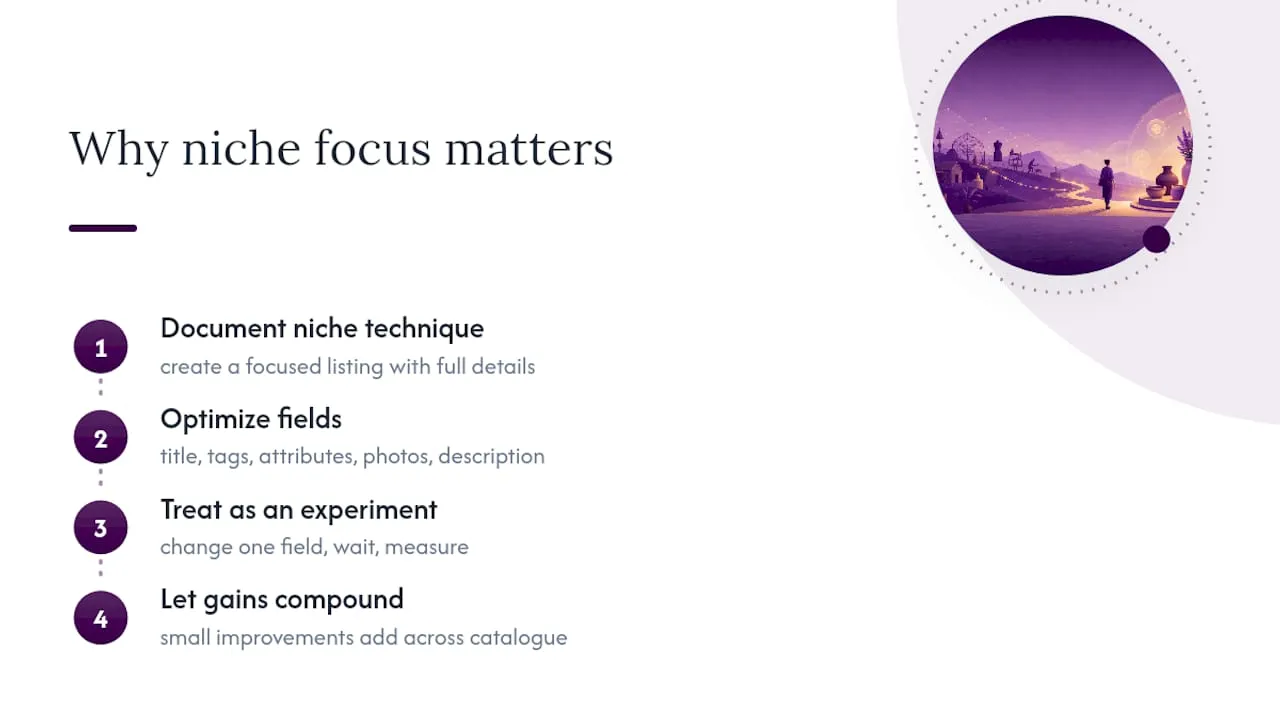
Small shops that document a narrow technique properly tend to outrank generic competitors, not because they trick an algorithm, but because they’ve simply given it more to match against. Every listing you optimise fully, title, tags, attributes, photos, description, is one more data point that tells search systems exactly what you make and who buys it.
Treat each listing as a small experiment rather than a finished object. Change one field, wait, measure. The improvements are individually small, but they compound across a catalogue faster than most sellers expect. What separates shops that grow steadily from ones that stall isn’t a secret trick. It’s whether anyone bothered to keep testing after the first listing went live.
— Rob
Speed up your listing work with Craftsuprint’s resources
Craftsuprint gives independent designers and hobby crafters a marketplace built specifically around printable craft downloads, so the category structure and metadata conventions you see there are a practical model for your own listings, not a generic template borrowed from a different industry entirely.
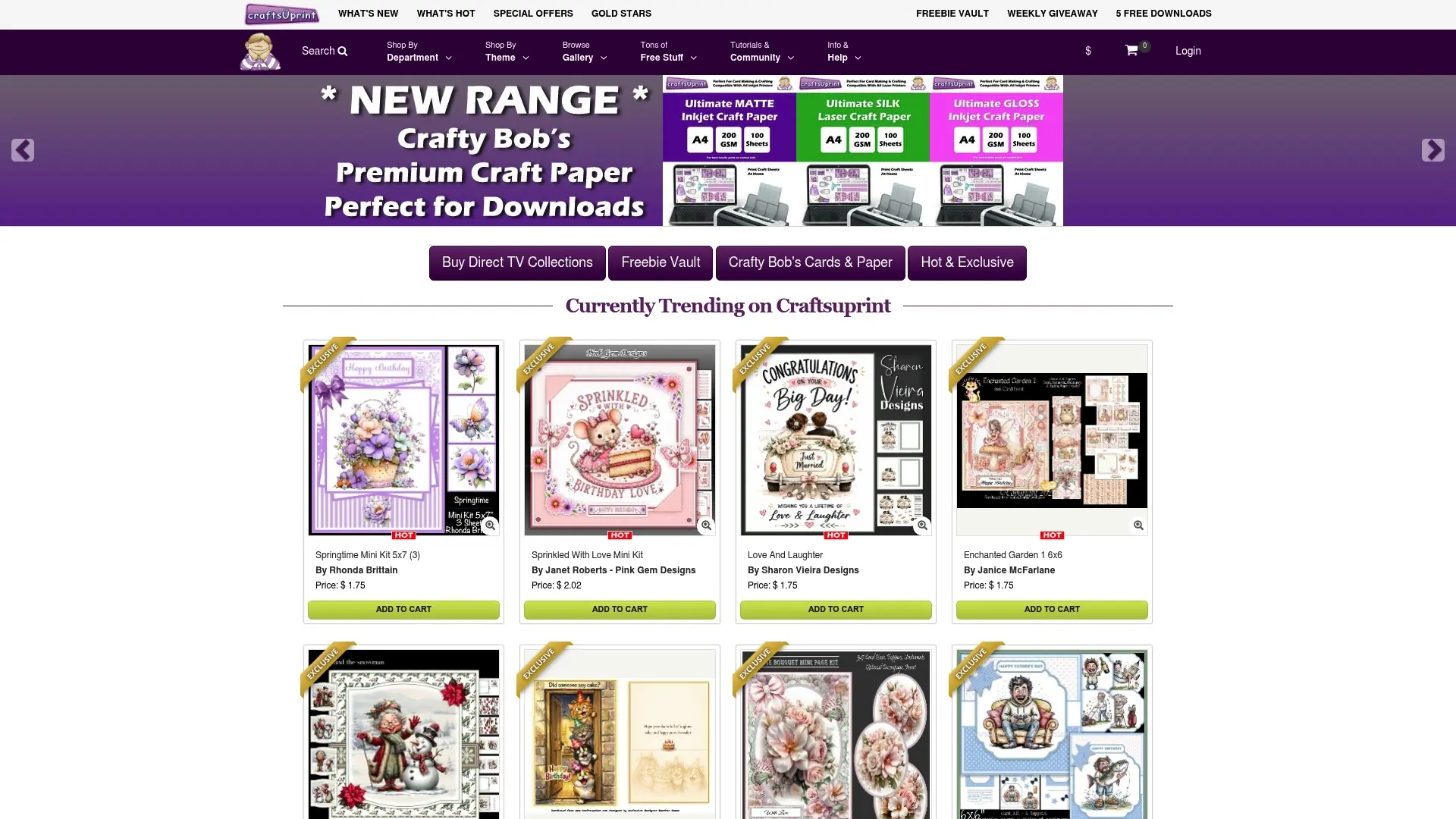
Browse the Card Making and Designer Resources categories to see how well-organised listings structure their titles, tags and product descriptions in practice. If you’re a designer rather than just a buyer, the Gold Star programme rewards sellers whose work earns consistent demand, giving you both income and a visible credibility marker on your shop. Pull up your worst-performing listing this week, run it through the eight-field checklist from earlier, and republish it with a stronger title and a corrected hero photo. Then check your Craft Supplies or Paper Craft listings next, since these categories tend to have the most competition and the most to gain from a proper metadata pass.
Sources
- How to Optimize Etsy Listings: The Complete 2026 Guide - Listadum
- Crafts SEO: Escape marketplace algorithms with owned search
FAQ
What is the 80/20 rule in SEO for craft listings?
Get those right first, since attributes and category are the highest-return, lowest-effort fix, according to Listadum’s guide.
What crafts are in high demand right now?
Demand shifts by season and occasion, but personalised items, card making supplies, cutting files for home crafters, and scrapbooking kits consistently see steady buyer searches. Rather than chasing trends, check your own sold filter data for what’s already moving in your specific niche.
What is an SEO listing?
An SEO listing is a product page written and tagged to match the exact words buyers type into search, using the title, tags, attributes, category and description as matching signals. It’s the practical application of craft listing SEO to a single product page rather than a whole shop.
What is the best platform to sell your crafts?
The right platform depends on what you make. Craftsuprint suits designers and makers selling printable craft downloads, card making kits and cutting files, offering category structure through pages like Cutting Files and Scrapbooking, plus the Gold Star programme for designer income and trust signals.