
3 Step Clipart License Checklist for Craft Sellers, Marketplace Ready

Yes, you can use clipart commercially, but only when the file carries a licence that explicitly permits it, such as CC0 public domain or a paid royalty-free licence. Before you list anything for sale, do three things: read the licence text word for word, note any attribution requirement, and save the receipt or licence screen somewhere you can find it in twelve months. Craftsuprint and Creative Commons both publish licence terms in plain language, which makes them a sensible starting point.
TL;DR:
- Only use clipart with explicit licences permitting commercial use, such as CC0 or royalty-free paid licences, and always verify the specific licence terms before purchasing.
- Commercial use includes selling products, promoting paid events, and even small fees that support costs, while personal or charity activities generally do not qualify unless explicitly stated.
- Reselling raw clipart files or using licensed images as trademarks or logos is usually prohibited, and high-volume sellers should review license caps and restrictions carefully.
- Keep detailed proof of licence purchase and usage, including screenshots, receipts, and licence text, to avoid disputes and demonstrate rights if queried later.
- Marketplace platforms like Craftsuprint clarify licence terms for each product, simplifying compliance and reducing licensing risks for small businesses.
Table of Contents
- What counts as commercial use for crafters and small shops
- Licence types that matter and what each actually permits
- Common licence restrictions and red flags to watch for
- How to check a clipart file’s licence and keep proof you can show later
- Practical do’s and don’ts: using clipart inside products you sell
- Marketplace licences and how Craftsuprint supports sellers
- My routine for staying out of licence trouble
- Find commercially licensed clipart and designs on Craftsuprint
- Where to check licence terms yourself
- Sources
- FAQ
What counts as commercial use for crafters and small shops
Commercial use means any activity connected to money, even loosely. Selling handmade cards on Etsy, listing a printable planner in your Craftsuprint shop, running a paid card-making workshop, and using an image in a paid Facebook advert for your business all count as commercial use under most licences. The moment clipart supports something you charge for, promote for profit, or use to build a paying audience, you’ve crossed from personal into commercial territory.
Personal use sits on the other side of that line: a birthday card for your nan, a scrapbook page nobody else will see, a poster for your own kitchen wall. Charity work occupies a grey zone that trips up a lot of well-meaning crafters. If you’re selling cards at a school fete and donating every penny to a good cause, that’s still commercial use in the eyes of most licences, because a sale took place. The licence rarely cares where the money ends up.
A few borderline cases catch people out repeatedly:
- Free giveaways bundled with a purchase — if someone has to buy something to receive the clipart, that’s commercial use, not a freebie.
- Samples and demo pieces — showing a design in your shop’s photography to sell the finished product counts, even if the sample itself isn’t for sale.
- Small fees for “just covering costs” — a nominal charge for printing or postage still makes the transaction commercial.
- Workshop handouts — printed materials for a paid class need the same commercial permissions as a product you’d sell outright.
Craftsuprint’s designer resources on clipart set out these distinctions clearly for sellers working across card making and paper crafts, which is worth a read before you assume a grey-area use is safe.
Licence types that matter and what each actually permits
Not all “free to use” claims mean the same thing, and confusing one licence type for another is where most crafters get into trouble. Four categories cover almost everything you’ll encounter.
CC0 and public domain. This is the most permissive tier available. Openclipart releases every image contributors upload under the Creative Commons Zero 1.0 mark, meaning you can use those files commercially with no attribution required at all. If a file is genuinely CC0, you could sell a thousand mugs printed with it and never need to credit the original artist. The catch is verifying it actually is CC0 and not just labelled that way by someone who copied it from elsewhere.
MIT-style permissive licences. Common in icon libraries, an MIT-style licence usually allows broad commercial re-use with minimal restriction, sometimes asking for a credit line buried in your app’s settings or a website footer. The Noun Project is the clearest example in this space: it offers straightforward licences built for commercial projects, spanning presentations, apps, and physical merchandise, though the exact attribution rule depends on whether you’re on a free or paid plan.
Royalty-free paid licences. This is the category with the most variation, and the one where “royalty-free” gets misunderstood. It doesn’t mean free of cost or free of rules. It means you pay once and don’t owe ongoing royalties per use, but the vendor’s specific licence text still governs what you can and can’t do. Some paid licences cap how many physical copies you can print. Others forbid using the asset in a logo. Read the actual document, not just the marketing blurb on the product page.
Standard versus extended licences. Many marketplaces split their commercial licences into two tiers. A standard licence typically covers small print runs and everyday website or social use. An extended licence removes those caps and often unlocks print-on-demand rights, mass merchandising, or redistribution allowances that the standard tier explicitly excludes.
Pro Tip: If a product page mentions “standard” and “extended” licences without a comparison chart, screenshot whatever licence text does exist before you buy. Vendors update product pages, and you want proof of the terms you actually purchased under, not whatever the listing says a year later.
One detail catches nearly everyone off guard: attribution rules often change depending on the tier you’re on, even within the same platform. A free download might require a visible credit, while the paid version of the identical asset removes that obligation entirely. Never assume the free and paid versions of a “similar-looking” file carry the same rules. Check each one on its own terms.
Common licence restrictions and red flags to watch for
Most licence disputes trace back to four recurring problems. Learn to spot these before you build a product around an asset, not after a platform flags your listing.
- Logos and trademarks are usually off-limits. Nearly every commercial clipart licence excludes using the artwork as your business logo or trademark. The reasoning is straightforward: a licence is typically non-exclusive, meaning the same image could end up in dozens of other businesses’ branding. You can’t claim exclusive trademark rights over something you don’t exclusively own, so licensors carve out branding uses to avoid that legal mess entirely.
- Reselling the raw file is almost always forbidden. You can build a greetings card, a mug design, or a printable planner using the clipart, but handing the source file to your customer, or letting them extract it from your product, breaches nearly every licence in existence. The rule of thumb: sell the finished thing, never the ingredient.
- Print-on-demand and cumulative caps catch high-volume sellers. Some licences set a hard ceiling, such as a maximum number of printed units per design, after which you need an extended licence. Others restrict which platforms you’re allowed to sell through entirely. If your product takes off and starts selling in the hundreds, go back and check whether your original licence still covers that volume.
- Vague “no sub-licensing” clauses deserve extra scrutiny. This wording usually means you can’t pass your licence rights to someone else, but the exact boundary shifts between vendors. If a licence document uses this phrase without defining it clearly, treat that ambiguity as a reason to ask the seller directly rather than guess.
Pro Tip: Keep a simple spreadsheet logging every commercial asset you use: the source, the licence type, the purchase date, and any print cap. It takes ten minutes per item and saves hours if a platform ever asks you to prove your rights.
How to check a clipart file’s licence and keep proof you can show later
Verifying a licence properly takes less time than most people fear, and it’s the single habit that separates crafters who sell confidently from those who panic when a platform sends a takedown notice.
- Find the licence text on the product page itself, not just the marketing description above it. Look for a dedicated “licence” tab or link, and copy the exact wording rather than paraphrasing it in your head. If the page only says “commercial use OK” with no further detail, that’s a gap worth questioning before you buy.
- Save your invoice, download receipt, and the licence text together, ideally in one folder per product. A PDF invoice with a timestamp, paired with a screenshot of the licence page from the same day, forms a reasonable evidence trail if anyone ever queries your right to use an asset.
- Preserve timestamps and file metadata where you can. A screenshot with the date visible, or a browser history entry showing when you accessed the licence page, adds weight to your records without any extra effort.
- Contact the seller directly for anything outside the stated licence. If you want to use an image for a purpose the licence doesn’t clearly cover, such as branding or a use case the wording doesn’t mention, ask in writing and keep the reply. A quick email exchange is far cheaper than a legal dispute later.
- Upgrade to an extended licence or commission original artwork when your plans outgrow the standard tier. If you’re scaling into large print runs, multiple platforms, or branding use, the cost of an extended licence or bespoke commission is small compared with the risk of building a business on a licence that doesn’t stretch that far.
Practical do’s and don’ts: using clipart inside products you sell
The safest mental model is this: clipart is an ingredient, not the finished dish. Combine it, adapt it, layer it into something bigger, and you’re almost always on solid ground. Sell the raw ingredient on its own, and you’ve likely broken the licence.
Do this:
- Combine multiple clipart elements with your own text, layout, and design choices to create something that’s clearly your own product.
- Modify colours, scale, and composition freely when the licence allows edits, which most commercial licences do.
- Check whether your specific product type, a printable planner, a digital template, a physical card falls under “redistribution” in the licence wording. Templates and planners sometimes sit in a grey area because the buyer receives a file they can print repeatedly themselves.
- Document your workflow: note which assets went into which product, and file the licence evidence in the same folder as your product listing photos.
Don’t do this:
- Don’t sell the clipart file on its own, bundled or unbundled, even if you’ve renamed it.
- Don’t use a piece of licensed clipart as your business logo without written, explicit permission for that specific use. A non-exclusive licence rarely covers exclusive trademark use, and building a brand identity around an asset you don’t own outright is a risk that grows every year your business runs.
- Don’t assume a printable product is exempt from redistribution rules just because it’s “just a PDF.” A digital planner that lets a customer print unlimited copies can function like redistribution in the eyes of some licences.
Pro Tip: When in doubt about whether your product counts as redistribution, ask yourself whether the buyer receives the original asset in a form they could extract and reuse elsewhere. If yes, check the licence twice before you list it.
Marketplace licences and how Craftsuprint supports sellers
A marketplace model makes licensing far less murky than scattered downloads across the open web, because each item carries its own licence text and purchase receipt tied to that specific product, not a vague blanket policy covering the whole site. That per-item clarity matters when you’re building a portfolio of products over months or years and need to trace exactly what you’re allowed to do with each one.
Craftsuprint’s designer resources hub lays out common licence restrictions and recommended practices for sellers working with clipart and printable designs, while the craft design licensing guide walks through how small sellers should interpret licence wording before listing a product.
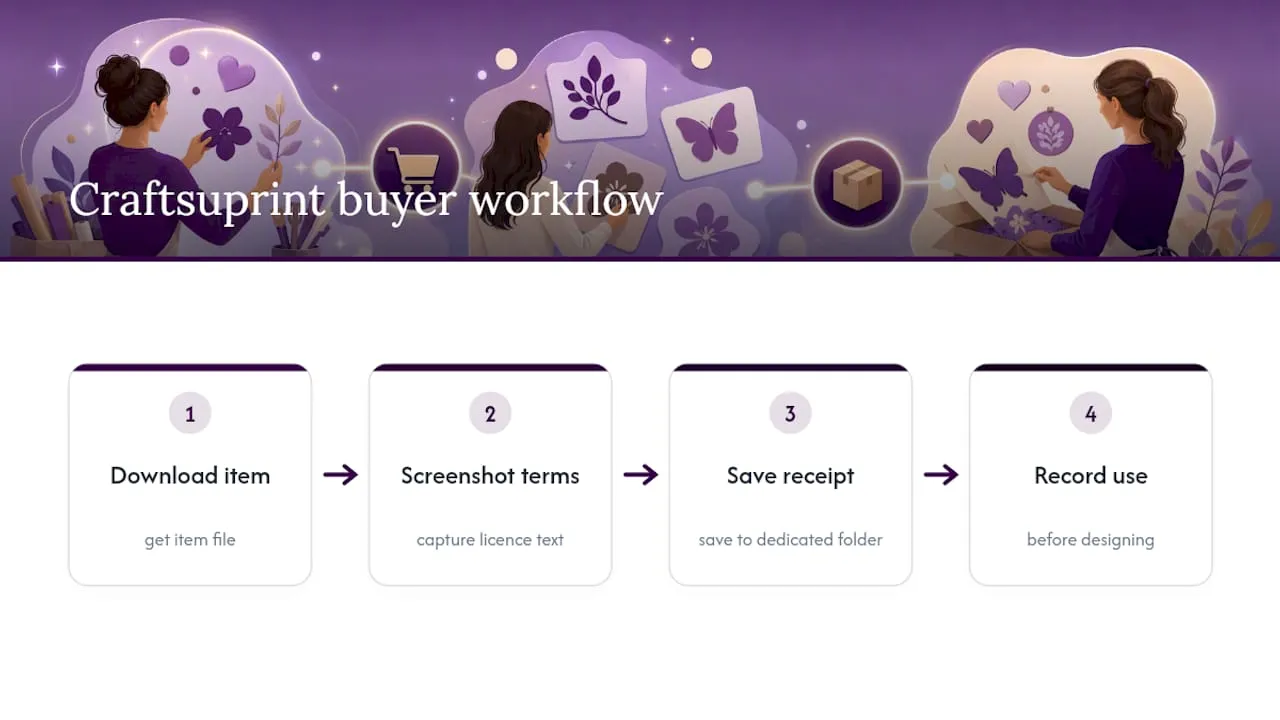
A sensible workflow for a Craftsuprint buyer looks like this: download the item, immediately screenshot the licence terms shown on the product page, save the purchase receipt to a dedicated folder, and note the intended product use before you start designing. That five-minute habit, covered in more depth in Craftsuprint’s licence check guide for printables, means you’re never scrambling for proof months after the fact.
My routine for staying out of licence trouble
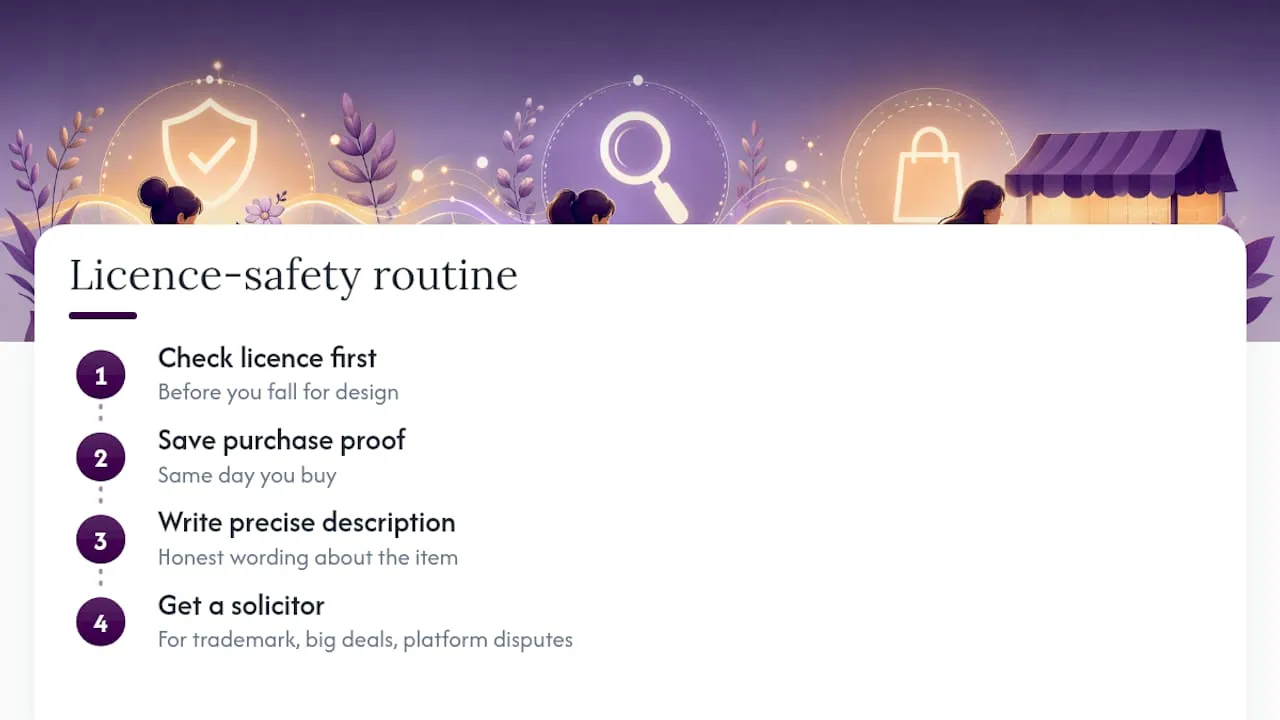
I keep this simple, and it’s worked every time I’ve applied it consistently: check the licence text before you fall in love with the design, save proof the same day you buy, and write your product description using precise, honest wording about what the item actually is. If you’re vague about what you’re selling, you’re more likely to accidentally misrepresent what rights you’re passing on to a customer.
Where I’d bring in a solicitor rather than rely on a licence FAQ: anything involving a registered trademark, a large-scale licensing deal with another business, or a dispute where a platform has already threatened legal action. Those situations move beyond what any article, including this one, can safely resolve for you. For the day-to-day business of selling cards, printables, and craft kits, the habits above cover the overwhelming majority of situations you’ll actually face.
— Rob
Find commercially licensed clipart and designs on Craftsuprint
This platform gives you a straightforward alternative to hunting across scattered free-clipart sites and hoping the licence holds up: every design on the marketplace comes with clear licence terms attached to that specific product, so you’re not left guessing which version of a file you downloaded or when the terms might have changed.
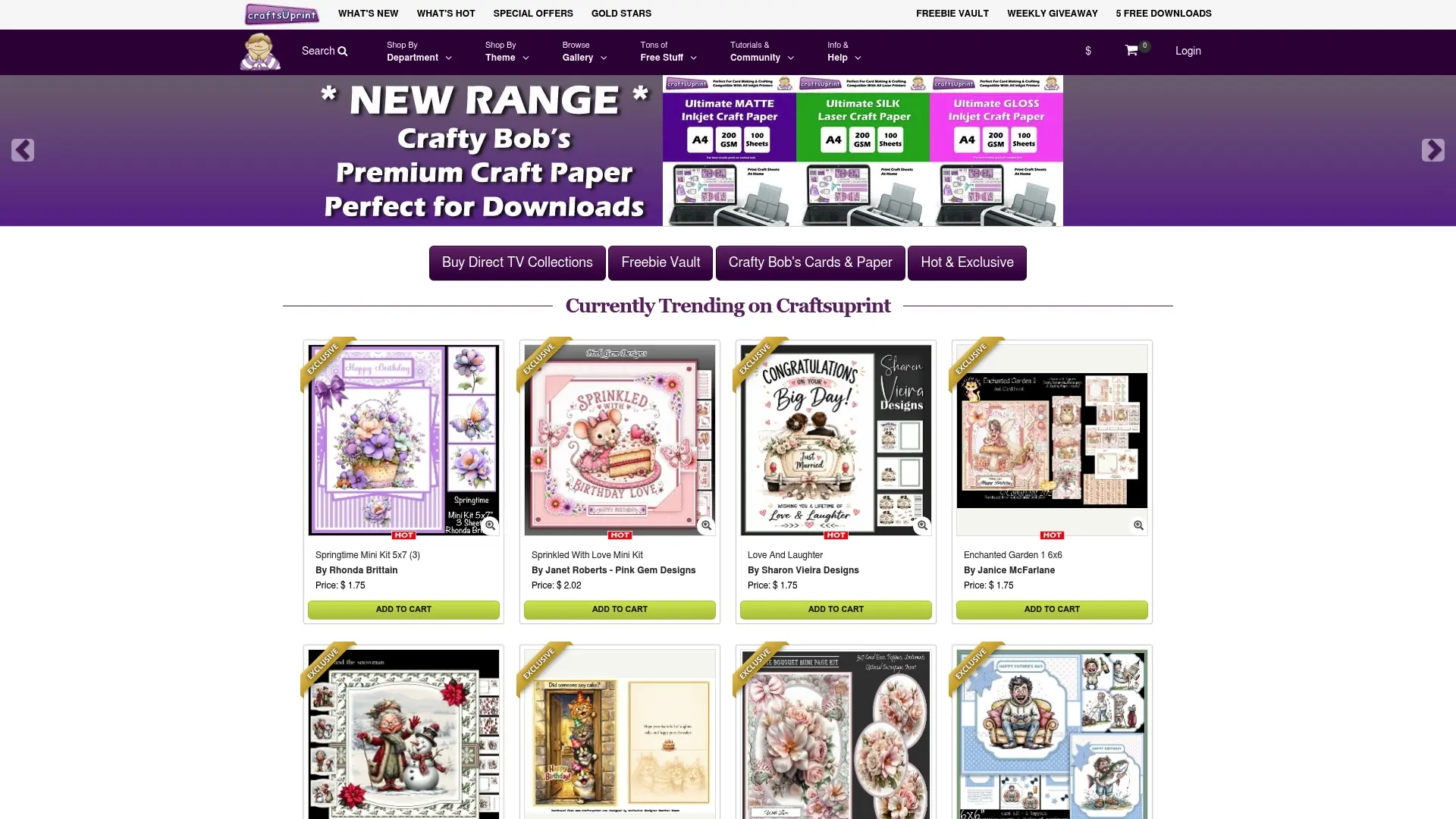
Browse the Create & Craft downloads section for licensed clipart, card kits, and paper patterns ready to use in products you sell, or explore the best art and craft franchises for sale in the UK if you’re a small-scale designer looking to list your own work under clear commercial terms. Whichever route you take, read the licence attached to each item and save your receipt before you start designing around it, that single habit prevents almost every dispute before it starts.
Where to check licence terms yourself
- Openclipart’s share page explains the CC0 public domain terms behind its library.
- The Noun Project sets out its commercial icon licensing options.
- Wordpress documents open-source licence principles worth understanding as background.
- Craftsuprint’s clipart designer resources cover marketplace-specific licence practices.
Sources
FAQ
Can I use clipart for commercial purposes?
Yes, provided the specific file carries a licence that permits commercial use, such as CC0 or a paid royalty-free licence. Always check the exact wording rather than assuming “free” means “free for business.”
How do I buy clipart for commercial use?
Look for a marketplace or platform that states commercial rights clearly on the product page, buy the correct licence tier for your intended volume, and save the receipt and licence text immediately after purchase.
Are clipart images copyright free?
Not automatically. Some clipart is released under CC0 and is genuinely free of copyright restriction, but most clipart remains copyrighted and simply comes with a licence granting you specific permissions, which is a different thing entirely.
Where can I get free clipart for commercial use?
Openclipart offers CC0 images usable commercially with no attribution needed, and some icon libraries like The Noun Project offer free tiers with attribution requirements. Always confirm the licence on the specific file you download, not just the site’s general claim.