
UK Crafters: 5 Minute Licence Checks for Commercial Use of Printables

Most commercial use licences let you sell finished physical items made from a printable design, such as printed cards or decorated stationery, without any trouble. What they almost never allow is reselling or sharing the printable file itself, and many cap how many units you can make before you need a higher tier. Check both points before you list a single product.
TL;DR:
- Most licences allow selling finished tangible products, but reselling or sharing the original digital file is almost always prohibited.
- Verify that the licence covers your specific product type, end-use, volume limits, and third-party printing permissions before listing any design.
- Flatten all design files into non-editable formats and keep detailed licence records for each purchase to protect against disputes.
- Using trademarked images, platform assets without creative modifications, or reselling source files can lead to takedowns, even if the product is physical.
- Contact designers directly for high-volume or special product needs and maintain clear documentation of all licence agreements.
Table of Contents
- What “commercial use” actually means for printables
- Four licence checks to run before you list a product
- Flatten your files, log your licences, vet your suppliers
- What’s safe to sell and what will get you a takedown notice
- Why designers and sellers rely on Craftsuprint for this
- Buying a commercial licence: what the process actually looks like
- Exclusive, non-exclusive, royalty-free and rights-managed, explained
- Can you edit a design and sell your version?
- Selling beyond the UK: copyright doesn’t work the same everywhere
- Crediting the designer without overcomplicating it
- The habit that actually protects small sellers
- Find printables with clear commercial terms on Craftsuprint
- Sources
- FAQ
What “commercial use” actually means for printables
A commercial use licence gives you permission to use a design, not ownership of it. Copyright sits with the original designer the moment they create the work, and in the UK that protection is automatic under the Copyright, Designs and Patents Act 1988. No registration, no paperwork required. Using someone’s printable design beyond what the licence permits counts as infringement even if you paid for the file.
The practical distinction that trips people up is physical versus digital end products. Print a design onto a card, mug or gift tag and sell that finished item? Most licences are fine with it. Turn the same design into a digital planner page or clipart pack and resell it as a downloadable file? That’s a completely different use, and most licences either forbid it outright or need a separate agreement, as explained in our guide to craft design licensing for small sellers.
Licence terms typically include a few recurring restrictions:
- Unit caps limiting how many finished items you can sell under one licence purchase
- Non-transferability, meaning you can’t hand the licence to another business or pass it on with the file
- No-resale clauses banning the sale of the original design file, edited or not
- Third-party printing limits, restricting whether a separate manufacturer can print the design on your behalf
The same legislation makes clear that a licence is permission, not a transfer of rights. Read every clause as if the designer is still standing behind their work, because legally, they are.
Four licence checks to run before you list a product
Run these four checks before your first sale, and repeat them any time you buy a new design from a different seller. Licence wording varies enormously between designers, even on the same marketplace, so don’t assume one purchase’s terms apply to the next.
- Confirm the allowed end-use. Read the licence for the specific product type you’re making. A licence covering “printed paper goods” doesn’t automatically cover engraved wood, laser-cut acrylic, or digital reproductions. If your end product isn’t named, email the designer and get it in writing rather than guessing.
- Check the file access rules. Editable templates and flattened, print-ready PDFs carry very different permissions. Many licences explicitly forbid extracting layers, vectors or fonts from a working file, even if you’re only using them in a finished product.
- Verify volume limits. Some licences cap sales at a fixed number of units (say, 500) before you need to buy a commercial-use upgrade. Selling more units than your licence allows is infringement even if every design element was used correctly.
- Check third-party manufacturing permissions. If you outsource printing to a subcontractor or use a print-on-demand service, the licence needs to allow that explicitly. Some designers restrict use to the original buyer’s own equipment only.
Pro Tip: Screenshot the full licence page the day you buy, not just the product listing. Sellers occasionally update their terms, and a dated screenshot proves what you agreed to at the time of purchase.
Flatten your files, log your licences, vet your suppliers
Three habits protect you if a licence dispute ever lands in your inbox, and none of them cost anything beyond a few minutes per purchase.
Flatten every file before it goes anywhere near production. Export working files as a non-editable PDF or high-resolution PNG rather than sending layered PSDs or editable SVGs to a printer or subcontractor. Flattening removes the temptation, deliberate or accidental, for someone downstream to extract and reuse the raw design elements. It also closes off the single most common licence breach: sharing an editable source file that a licence never authorised anyone to touch.
Keep a licence log for every design you buy. At minimum, store:
- The purchase receipt or order number
- A saved or screenshotted copy of the licence terms as they read on the day of purchase
- The final file name and where you used it (which product line, which platform)
A folder structure by designer name, with a subfolder per purchase, takes ten minutes to set up and saves hours if a designer or platform ever questions your use. Our piece on selling digital crafts walks through a simple version of this system.
When you work with a printer, packer or subcontractor, get written confirmation that they’re allowed to handle third-party licensed designs on your behalf. Some manufacturer agreements require the licence holder to print the plans themselves.
Pro Tip: If you’re scaling into hundreds of units a month, or building a product line around one designer’s work, email them directly and ask about a bespoke commercial agreement. It’s often cheaper than repeatedly upgrading a standard licence.
What’s safe to sell and what will get you a takedown notice
Printed greeting cards, stickers applied to finished goods, pressed mugs, and finished stationery items sit firmly in safe territory when your licence permits physical commercial sale. You’ve transformed the design into a tangible product, and that’s exactly what most standard licences are written for.
The risky end of the spectrum looks different, and it’s where most disputes start:
- Selling the editable or layered source file (SVG, PSD, AI) rather than a finished product
- Bundling clipart made from someone else’s design elements and reselling that bundle as your own asset pack
- Using trademarked artwork, brand logos, or recognisable characters without a licence, even on a physical item
- Using platform-generated assets, such as Canva elements, without adding enough original creative work to make the final piece your own
Fonts and text deserve a separate mention. A commercial-use licence on a printable design doesn’t automatically extend to any font used in it. Check the font’s own licence separately, and be cautious with song lyrics, quotes, or stylised trademarks; these can carry protections beyond the artwork itself. The overview from Sprintlaw UK on common seller infringements is worth ten minutes of your time before you list anything with borrowed text.
Why designers and sellers rely on Craftsuprint for this
The platform has developed as a specialised marketplace built around printable craft designs, making licence clarity a fundamental part of its operation. Independent designers list their own terms alongside each product, and a rewards programme recognises designers whose work sellers frequently purchase, which tends to correlate with clear, honest licensing.
If a licence term isn’t obvious from a product listing, contacting the designer directly through the platform is the fastest way to get written permission for an edge case, whether that’s a higher print run or an unusual end product. The craft design licensing guide and the piece on printable templates on the Craftsuprint blog both go deeper into recordkeeping habits worth borrowing, including simple licence-log formats you can adapt for your own files.
Buying a commercial licence: what the process actually looks like
Buying a commercial use licence usually happens one of three ways, and which one applies depends on how the designer sells their work.
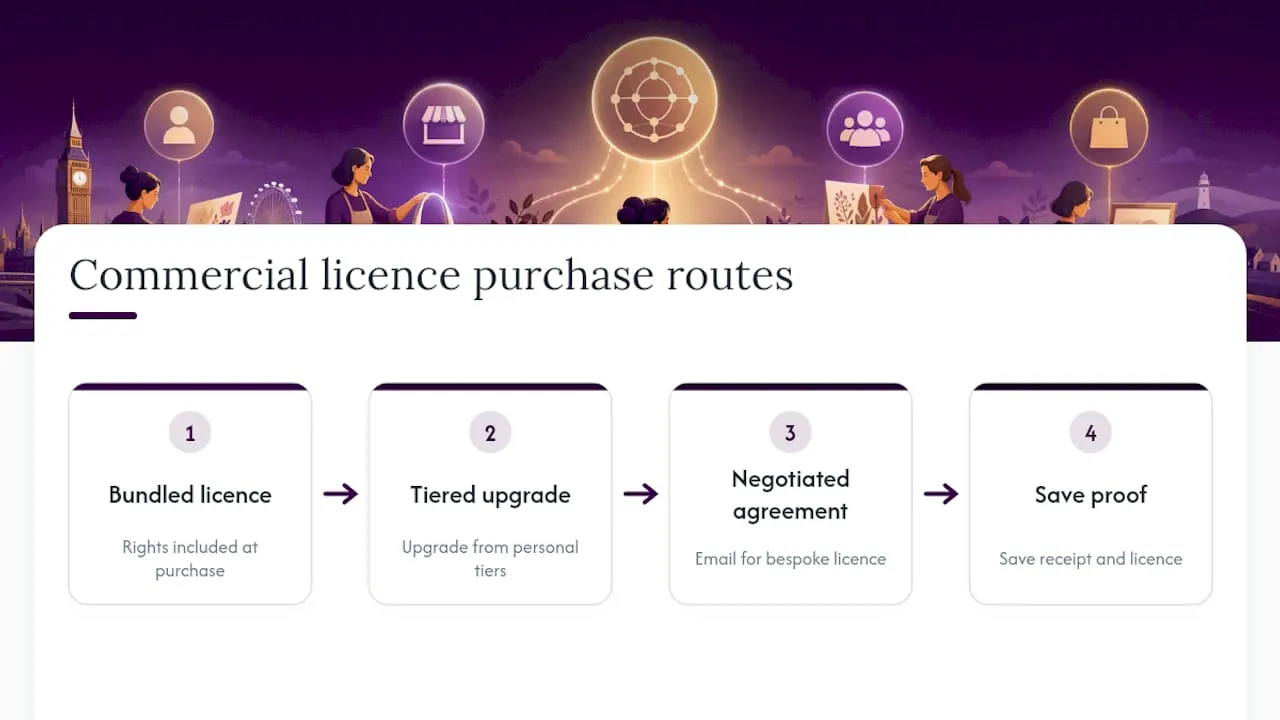
The most common route is a bundled licence, where commercial rights are included automatically with the purchase price of the design. You buy the file, the licence terms are stated on the product page, and you’re covered for whatever that specific licence permits, no separate transaction needed.
The second route is a tiered upgrade. Some designers sell a personal-use version cheaply and a commercial-use version at a higher price, sometimes with unit caps built into different tiers (250 units, 1,000 units, unlimited). If you started with a personal licence and want to sell products, check whether an upgrade path exists before assuming you need to repurchase the whole design.
The third route is a direct, negotiated agreement. For high-volume production, exclusive use, or unusual end products not covered by standard terms, email the designer and ask for a bespoke licence in writing. This is common when a small business wants to build a product line around one artist’s style and needs guarantees a standard licence doesn’t offer.
Whichever route applies, save the transaction confirmation and the exact licence wording at the point of purchase. Licence terms can change for future buyers, so what you agreed to needs to be preserved as it stood on your purchase date, not what the listing says a year later.
Exclusive, non-exclusive, royalty-free and rights-managed, explained
These four terms get used loosely across craft marketplaces, and mixing them up leads to real confusion about what you’re actually allowed to do.
A non-exclusive licence is the standard for most printable designs. The designer can sell the same design to dozens of other buyers, and you’re one of many people permitted to use it commercially. This is by far the most common structure on craft marketplaces because it lets designers earn from repeat sales of the same file.
An exclusive licence means the designer agrees not to sell that specific design, or license it for that specific use, to anyone else. These are rare in the printable craft space and usually cost significantly more, because the designer is giving up future income from that design elsewhere.
Royalty-free doesn’t mean free. It means you pay once and don’t owe ongoing royalties per unit sold afterwards, regardless of how many finished items you produce within the licence’s other limits (unit caps still apply if stated). Most printable craft licences are structured this way, though specific terms vary by designer.
Rights-managed licensing is far less common in the hobby craft space than in stock photography, but it means the licence terms are calculated around a specific, narrow use (a particular print run, timeframe, or territory) rather than a broad blanket permission. If you ever see rights-managed terms attached to a printable, read the scope carefully. It’s usually narrower than it first appears.
Can you edit a design and sell your version?
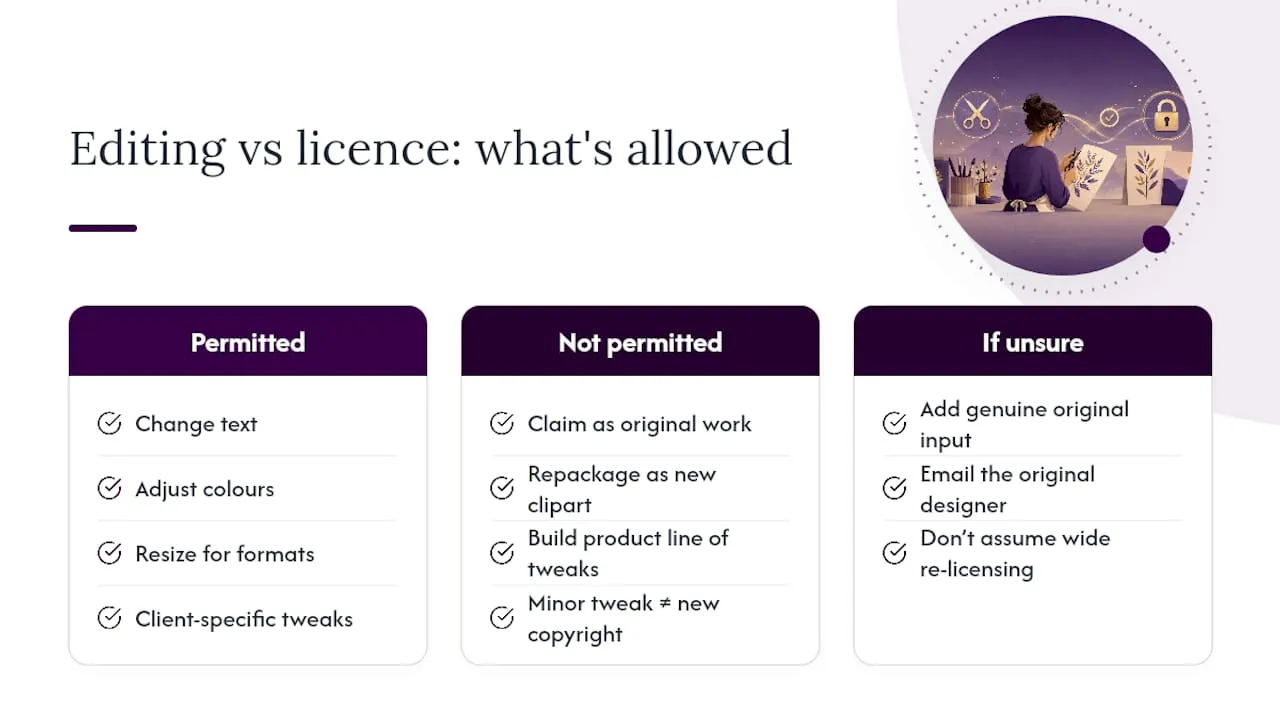
Modifying a licensed design doesn’t create a clean break from the original licence, and that surprises a lot of sellers. The underlying copyright still belongs to the original designer, even after you’ve recoloured a background, resized elements, or combined a design with your own artwork.
Most standard commercial licences permit reasonable customisation, such as changing text, adjusting colours to match a client’s request, or resizing for different product formats, where allowed by the licence. What they don’t permit is claiming the modified result as an entirely original work you’re free to license to others, or building a new product line that’s substantially the original designer’s artwork with minor tweaks.
The key legal test, drawn from how platforms like Canva frame their own asset licensing, is whether you’ve added genuine original creative input. A finished card that uses a licensed floral motif alongside your own layout, typography and colour choices is a transformed product. Taking that same motif, tweaking one colour, and reselling it as a new “clipart pack” is not. The difference isn’t the amount of editing time you spent; it’s whether the result stands as your own creative contribution rather than a repackaged version of someone else’s design.
If you’re building an entire product range around modified versions of one designer’s work, that’s exactly the scenario worth emailing them about directly, rather than assuming standard licence terms stretch that far.
Selling beyond the UK: copyright doesn’t work the same everywhere
Copyright protection exists in most countries, but the specifics, duration, and enforcement mechanisms vary, and that matters the moment you sell to buyers outside the UK or use a printable design bought from an overseas designer.
The UK’s automatic protection under the Copyright, Designs and Patents Act 1988 is broadly mirrored in other jurisdictions thanks to international treaties like the Berne Convention, which most countries have signed. That means a design created in one member country generally receives some copyright recognition in others. What doesn’t automatically transfer is the specific licence wording a designer attaches to their product, because licence terms are a private contract, not a copyright statute, and contract enforcement varies far more between countries than copyright recognition does.
If you’re selling internationally through an online marketplace, or buying designs from a designer based outside the UK, a few practical points matter more than the legal theory. Read whether the licence specifies a governing jurisdiction; some do, most don’t. Assume that a licence silent on international resale doesn’t automatically grant it. And if you’re shipping physical products made from a licensed design into a country with notably different IP enforcement norms, that’s a reasonable moment to ask the designer directly rather than assume UK-style licence logic applies everywhere.
Crediting the designer without overcomplicating it
Attribution isn’t usually a legal requirement under a standard commercial use licence, unless the licence specifically states it as a condition, but it’s good practice and it protects your reputation as a seller.
For physical products, a small printed credit on packaging or an insert card (“Design used under licence from [Designer Name]”) is enough, and it signals to customers that you take licensing seriously. It also does you a favour if a designer or platform ever questions your use: visible, voluntary attribution is a small but genuine piece of evidence that you weren’t trying to obscure the design’s origin.
For digital listings, whether on your own website or a marketplace, a line in the product description crediting the original design source works the same way. Keep the wording factual rather than promotional; you’re not endorsing the designer’s other work, you’re simply noting where the design element came from.
The one place attribution becomes mandatory rather than optional is when a licence explicitly requires it as a condition of use. Some free or discounted licences trade a lower price for a mandatory credit line, and skipping that requirement technically breaches the licence even if the underlying use was otherwise fine. Read for that clause specifically; it’s easy to miss because it often sits at the bottom of a licence page rather than near the pricing terms.
The habit that actually protects small sellers
Most licence disputes I’ve seen described in seller communities don’t come from bad faith. They come from someone assuming a licence covers a use it never mentioned, because reading full licence text feels like unnecessary friction when you just want to get a product listed. That assumption is the actual risk, not deliberate corner-cutting.
The advice that gets repeated most, “just read the licence,” is technically correct and practically useless on its own, because licence wording is inconsistent across designers and platforms. What works better is treating licence-checking as a five-minute habit attached to every single purchase: screenshot the terms, note the unit cap if there is one, and file it before you forget which licence covers which file. Do that consistently and you’ll never be caught relying on memory during a dispute.
If there’s one thing hobby sellers underrate, it’s how much a simple licence log protects them, not because disputes are common, but because the cost of keeping one is close to zero and the cost of not having one, if a designer or platform ever asks, is disproportionately high.
— Rob
Find printables with clear commercial terms on Craftsuprint
Craftsuprint is built specifically for the situation this article just walked through: buying printable designs where the commercial licence terms are stated clearly on the product page, not buried in a separate document you have to hunt for. Every design category, from card kits to paper patterns, carries its own licence information alongside the listing, so you’re checking terms in the same place you’re browsing.
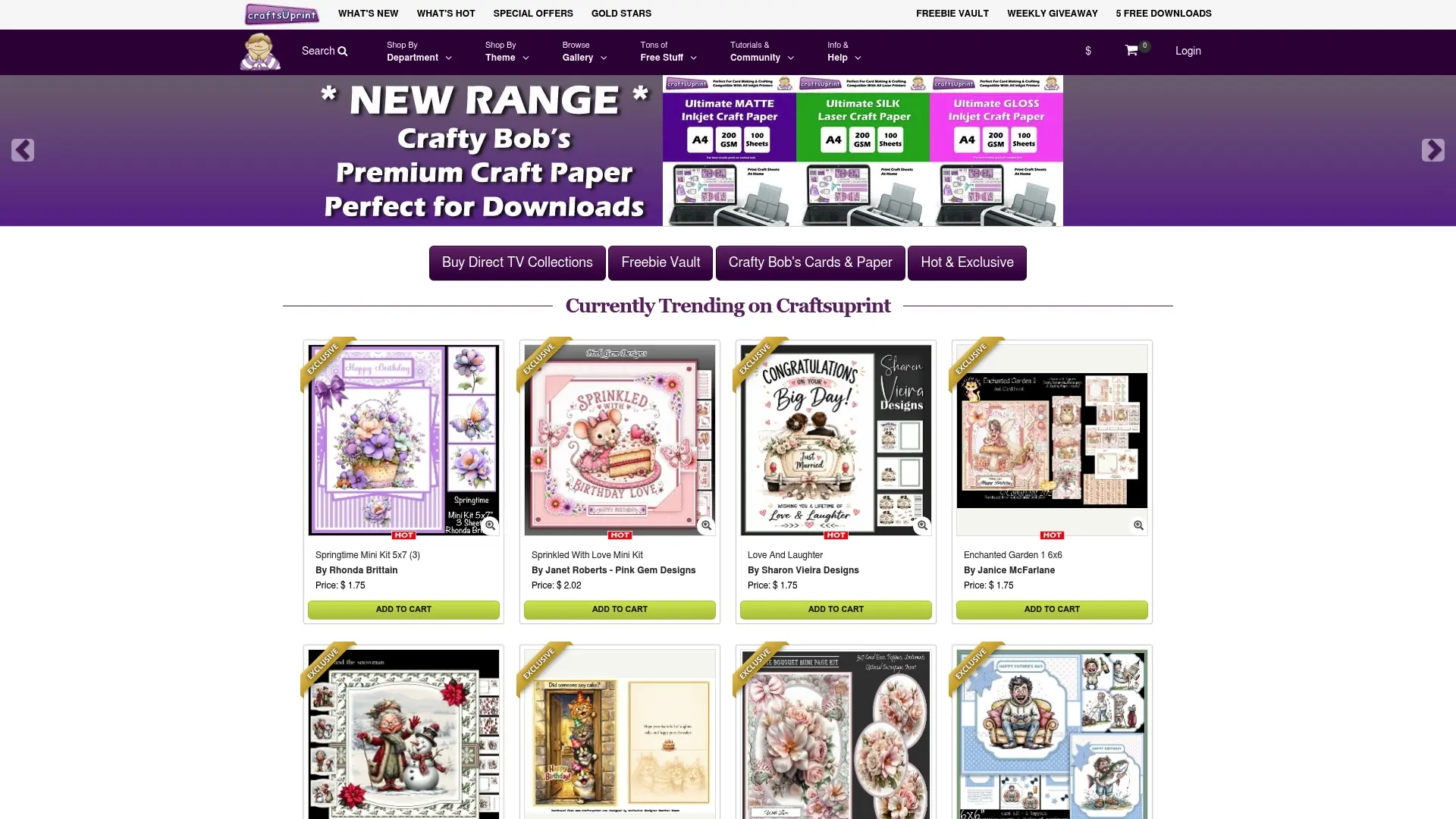
Beyond licence clarity, the community side offers independent designers and small sellers opportunities such as weekly freebies to test new styles, contests to showcase work to other crafters, and a rewards programme recognising popular designers. If a licence question ever arises on a specific design, messaging the designer directly through the platform is possible.
Ready to browse? Head to the Create & Craft downloads section to see licence-labelled printables across every category, or explore the wider craft supplies range if you’re building out a full product line around your next design purchase.
Sources
FAQ
Can I sell items I make using a printable I bought?
Yes, in most cases, provided your licence permits commercial use and covers the specific end product you’re making. Always check the licence for unit caps and end-use restrictions before scaling production.
Does buying a commercial licence mean I own the design?
No. A licence grants permission to use a design under stated conditions; copyright stays with the original designer under the Copyright, Designs and Patents Act 1988 unless a separate written assignment transfers ownership.
Can I resell the printable file itself, not just the finished product?
Almost never under a standard commercial licence. Reselling editable or flattened source files is one of the most common licence breaches sellers make, even when the finished-product use was fully allowed.
What’s the difference between personal use and commercial use licences?
Personal use licences only cover items made for your own home or gifts; commercial use licences add permission to sell finished products for profit, often with unit caps or price differences reflecting that broader use.
Do I need to credit the designer when I sell a product made with their design?
Only if the licence explicitly requires it as a condition, but adding a small credit is good practice regardless and can help demonstrate good faith if a licence question ever comes up.