
Craft Sellers: Bundle vs Single Listings, Mix to Avoid 20% Sales Drop
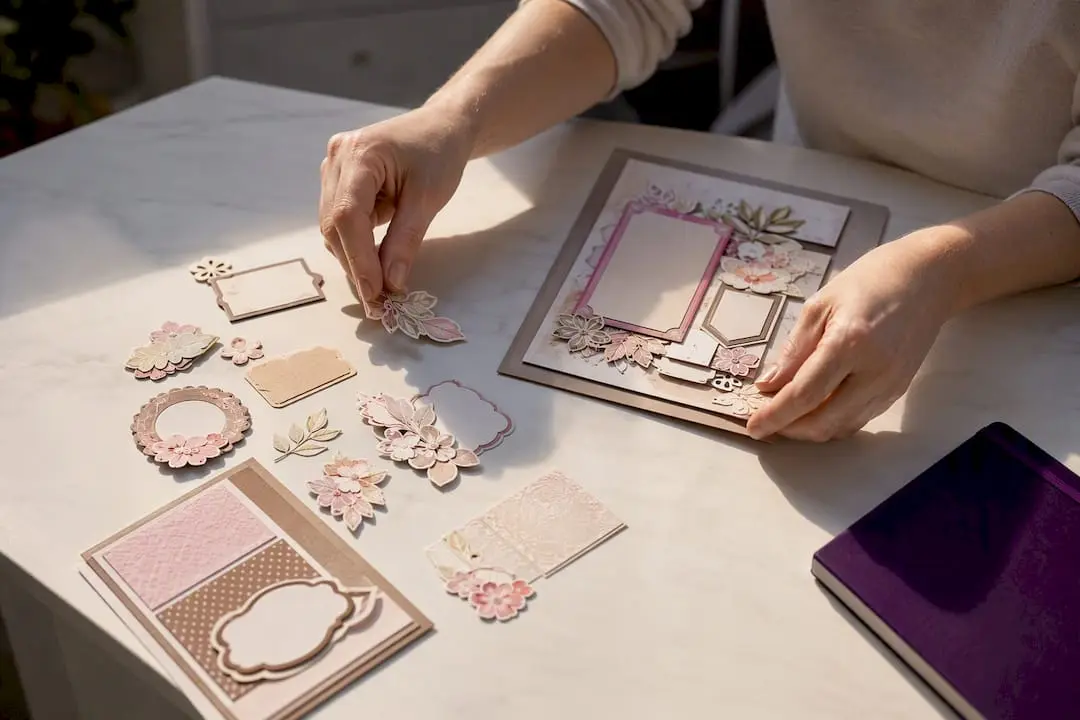
For most sellers, mixed bundling wins: keep your best sellers available as single listings, then layer bundles on top for buyers who want convenience or a deal. Bundles usually lift average order value and burn through slow stock; singles protect search visibility and let buyers who want just one thing find and buy just one thing. Craft platforms like Craftsuprint show this pattern clearly with digital downloads and mini kits.
TL;DR:
- Bundles should be paired with single listings unless the product is designed as a system or refill pack, as going bundle-only can reduce total sales by about 20%.
- Offering a 10% discount on bundles tends to optimize contribution per order, balancing increased attach rates with margin preservation.
- Track key metrics such as attach rate, contribution, conversion, return rate, and component sell-through time when testing bundle effectiveness.
- Maintain accurate component stock levels and consistent descriptions to prevent overselling and disputes, especially for shared or slow-moving items.
- Use bundles for curated, theme-based projects that add genuine value, rather than simply grouping unrelated items or offloading slow stock.
Table of Contents
- Bundle vs single listings: the real pros and cons
- When should you offer bundles, singles, or both?
- How much should you discount a bundle?
- Inventory, fulfilment and returns: the operational side
- How to test whether a bundle is actually working
- Practical bundle ideas for craft sellers on Craftsuprint
- Why buyers choose bundles over single items (and vice versa)
- Do bundles or singles do more for your brand?
- What bundling looks like across different industries
- Legal and compliance points sellers often miss
- Author perspective — when I use bundles
- Publish your own bundles and mini-kits on Craftsuprint
- Sources
- FAQ
Bundle vs single listings: the real pros and cons
The trade-off isn’t bundles versus singles. It’s what you lose when you pick only one.
Bundles genuinely help in three ways. They increase average order value by getting buyers to add related items in one transaction rather than three separate ones, and they move slow-moving stock when you pair it with a high-velocity item. They also cut your listing workload since one bundle page can replace several individual product descriptions, and a well-curated bundle simply feels like better value than the sum of its parts.
The costs are just as real. Bundling several SKUs together complicates inventory tracking, since one popular bundle can quietly deplete a component that also sells alone. Deep discounts to make a bundle look attractive can eat into margin fast. And bundles can cannibalise your single-item sales: someone who only wanted one item might buy the bundle anyway, but someone who only wanted the bundle price might now skip the single listing entirely.
Single listings solve different problems:
- They build search visibility, since each individual title, description, and set of keywords is its own chance to rank.
- They give buyers exact choice, so nobody pays for four items to get the one they actually wanted.
- Returns and replacements are simpler because a fault or mismatch affects one item, not a whole set.
When should you offer bundles, singles, or both?
Run each product through five questions before deciding its format.
- What job is the buyer doing? If they’re finishing a single project (one card, one page), a single listing serves them faster. If they’re stocking up or starting a themed project, a bundle removes friction.
- How complementary are the items? Genuinely related items (a card kit plus matching insert) make a coherent bundle. Randomly grouped items just look like inventory dumping.
- What’s your margin cushion? Thin margins can’t absorb a steep bundle discount without turning a “bestseller” into a loss leader.
- How fast does the stock move? Slow-moving components are prime bundle candidates when partnered with a fast seller.
- Is there search demand for the single item? If shoppers are actively searching for that exact product, keep a standalone listing live regardless of any bundle you also offer.
The practical rule: default to mixed bundling, where singles and bundles coexist, for the bulk of your catalogue. Research from Harvard Business School found that going bundle-only can cut total sales by around 20%, because it strips away the search visibility and single-item buyers that standalone listings capture. Reserve pure bundling (bundle-only, no singles available) for refill packs, exclusive kits, or systems designed to be sold as a locked set.
How much should you discount a bundle?
Discount depth is the single easiest way to wreck a bundle’s economics, and it’s usually set by guesswork rather than maths. Eightx’s modelling on DTC bundling puts typical bundle AOV uplift at roughly 15–30%, but that uplift means little if the discount eats the extra revenue. Their analysis found a discount around 10% often produces the best contribution per order, better than steeper cuts that boost basket size but shrink margin.
| Discount depth | Effect on attach rate | Effect on contribution per order |
|---|---|---|
| 5% | Modest lift | High contribution retained |
| 10% | Strong lift | Often the sweet spot |
| 20%+ | Highest lift | Contribution frequently falls |
Set your floor from the maths, not a round number. SureCart’s pricing guidance recommends calculating your minimum profitable price from variable costs and your target contribution margin first, then choosing the maximum discount you can sustain against that number.
For the sales copy itself, anchoring beats a bare bundle price. Showing “Worth £24, yours for £19” consistently outperforms stating the bundle price alone, because it gives the buyer a reference point for the saving.
Pro Tip: Before touching your discount, fix the merchandising, placement, and bundle description first. Improving how a bundle is presented often lifts attach rate more than a deeper discount ever will.
Inventory, fulfilment and returns: the operational side
Bundles create a stock problem singles don’t: one shared component can sell out from underneath you.
- Map every bundle against its component stock levels so a single fast-moving item doesn’t silently trigger an oversell across three different bundles.
- Reserve stock for components used in multiple bundles, or build in a substitution rule if one runs low.
- Keep bundles as one parcel wherever possible. Splitting a bundle across shipments or triggering a dimensional-weight surcharge erases the order-cost leverage that made bundling attractive in the first place.
- Photograph and describe every component clearly. Vague bundle listings generate more disputes than clear ones, simply because buyers aren’t sure what they’re getting.
Pro Tip: Track returns by bundle SKU, not just by product. If one component is driving most of the disputes, pull it from the bundle before the whole bundle’s rating suffers.
How to test whether a bundle is actually working
Don’t trust gut feel. Track five numbers before deciding a bundle stays.
- Attach rate: the percentage of buyers who add the bundle over a single item.
- Average order value and contribution per order: AOV tells you basket size; contribution tells you what’s actually left after costs and discount, which matters more.
- Conversion rate on the bundle’s own product page versus the single-item pages it replaces.
- Return rate, specifically for bundled orders compared with singles.
- Time-to-sell for the components once they’re locked into a bundle versus when they were listed alone.
Run this as a genuine test: an A/B split between a bundle page and a single-item page, a shallow-discount version against a deep-discount version, and a post-purchase upsell offer instead of a pre-purchase bundle. Shopify’s guidance on retail bundling flags two red flags worth pausing on: rising bundle-specific returns, and a component that keeps going out of stock. Either signals the bundle needs reworking, not just restocking.
Practical bundle ideas for craft sellers on Craftsuprint
Craft sellers have a natural advantage here: digital downloads cost nothing extra to bundle, so the usual stock-depletion risk barely applies.
Theme-based project kits work particularly well, grouping a card front, insert, and matching embellishment set around one occasion. Mini-kits bundling three or four related toppers into one purchase suit buyers who want variety without hunting through individual craft downloads one at a time. Coordinated download sets built around a single colour palette or season also convert well, and refill packs suit buyers who’ve already bought a base kit and want more of the same style.
On the listing itself, list every component by name rather than a vague “assorted designs” label, and show a compare-at price (“Worth £X individually, yours for £Y”) so the saving is obvious. Craft buyers respond to seeing exactly what they’re getting, which is also why keeping strong single digital craft listings alongside your bundles still pays off in search traffic.
Why buyers choose bundles over single items (and vice versa)
Bundles and singles appeal to two different mental modes, and confusing them is where a lot of sellers go wrong.
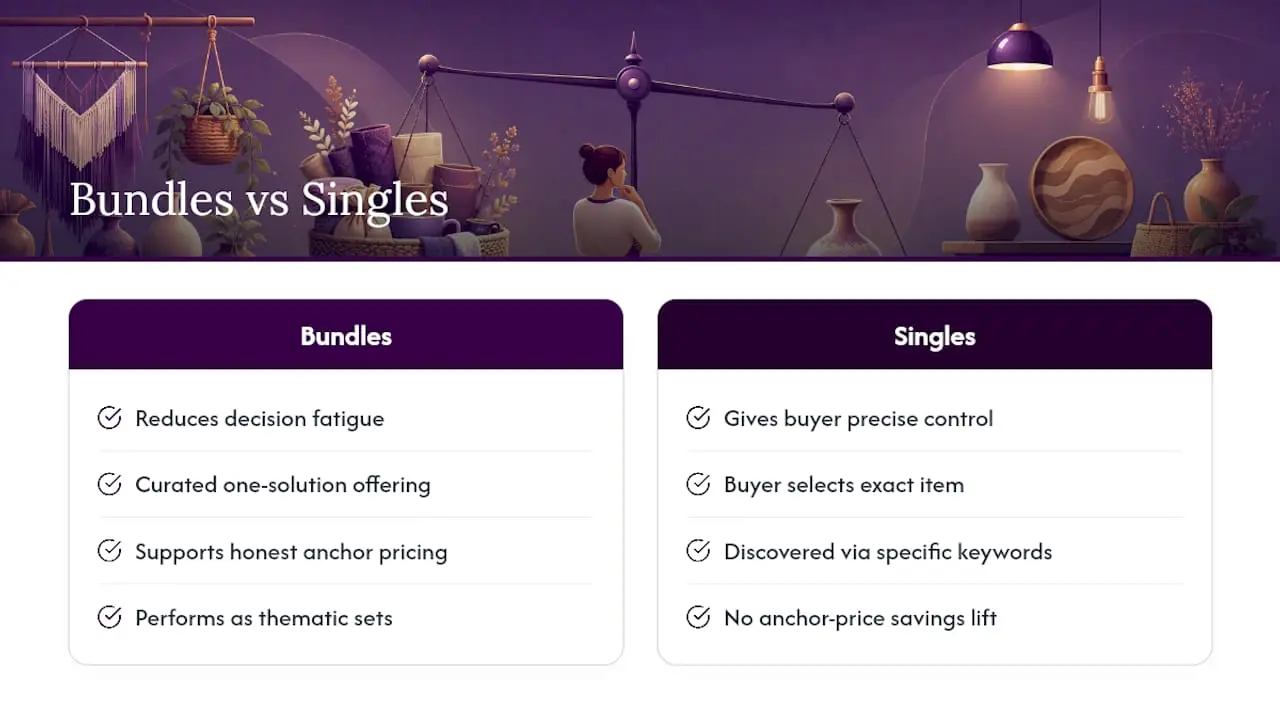
Buyers reach for bundles when they want to reduce decision fatigue. Faced with dozens of similar craft downloads, a curated “complete project” bundle does the choosing for them, and that convenience is worth paying a small premium for. This is why thematic bundles that solve a specific job, like “everything for a Christmas card,” consistently outperform random assortments. The buyer isn’t evaluating five products; they’re evaluating one solution.
Single listings appeal to a different instinct: control. A buyer who already knows exactly what they want doesn’t want to pay for three extra items to get it, and forcing them into a bundle often pushes them to abandon the purchase entirely rather than overpay. This is also the buyer most likely to search by specific keyword, which is why standalone listings capture demand bundles never see.
There’s a pricing psychology angle too. A bundle’s anchor price (“Worth £24, yours for £19”) works because it reframes the purchase as a saving rather than a spend. Strip that anchor away and show only the £19 price, and the same bundle converts less. Singles don’t get this lift because there’s no comparison point to anchor against. It’s a genuine advantage bundles hold that single listings simply can’t replicate, but it only works when the anchor price is honest. An inflated “worth £40” tag on a bundle that’s obviously not worth £40 damages trust faster than any discount builds it.
Do bundles or singles do more for your brand?
How you bundle says something about your judgement as a seller, whether you mean it to or not.
A well-curated bundle signals expertise. Grouping a card base, sentiment, and matching embellishment together tells the buyer you understand how these pieces work together, and that curation is worth something on its own. It’s the difference between a shop that just lists products and one that clearly understands its own catalogue.
A poorly built bundle does the opposite. Randomly grouping unrelated items to shift dead stock reads as exactly that, and buyers notice. It can also quietly undercut your pricing credibility: if your “premium” single listing sits at £8 but a bundle throws five similar items in for £12, the single starts to look overpriced by comparison, even if it isn’t.
Single listings, meanwhile, build a different kind of reputation. A shop with strong, well-described individual listings looks organised and confident in its own products. It also gives returning buyers an easy way to find exactly the one design they remember, rather than hunting through bundles to spot it. The strongest sellers use both deliberately: singles to demonstrate range and searchability, bundles to demonstrate curation. Leaning entirely on one or the other leaves a gap in how professional the shop feels.
What bundling looks like across different industries
The mixed-bundling pattern shows up almost everywhere retail exists, just with different components.
Software companies bundle features into tiers rather than selling every function separately, because buyers would otherwise agonise over which individual features they actually need. Meal-kit services bundle recipe plus ingredients because the entire value proposition is removing the planning step, not the food itself. Beauty brands bundle a full-size product with trial sizes of related items, using the bundle to introduce buyers to products they wouldn’t have bought individually.
In digital craft and print markets specifically, the same logic holds. One craft-file marketplace analysis found that listing files individually first builds the search reach and sales data sellers then use to assemble bundles that actually convert, rather than guessing which combinations might sell. That sequencing matters: bundle too early, before you know which singles perform, and you risk bundling your weakest sellers with your strongest ones and diluting both.
The common thread across every industry is the same one that applies to craft downloads: bundles work best when they remove a genuine decision cost for the buyer, not when they’re simply a container for whatever didn’t sell on its own.
Legal and compliance points sellers often miss
Bundle pricing claims sit closer to consumer protection law than most sellers assume.
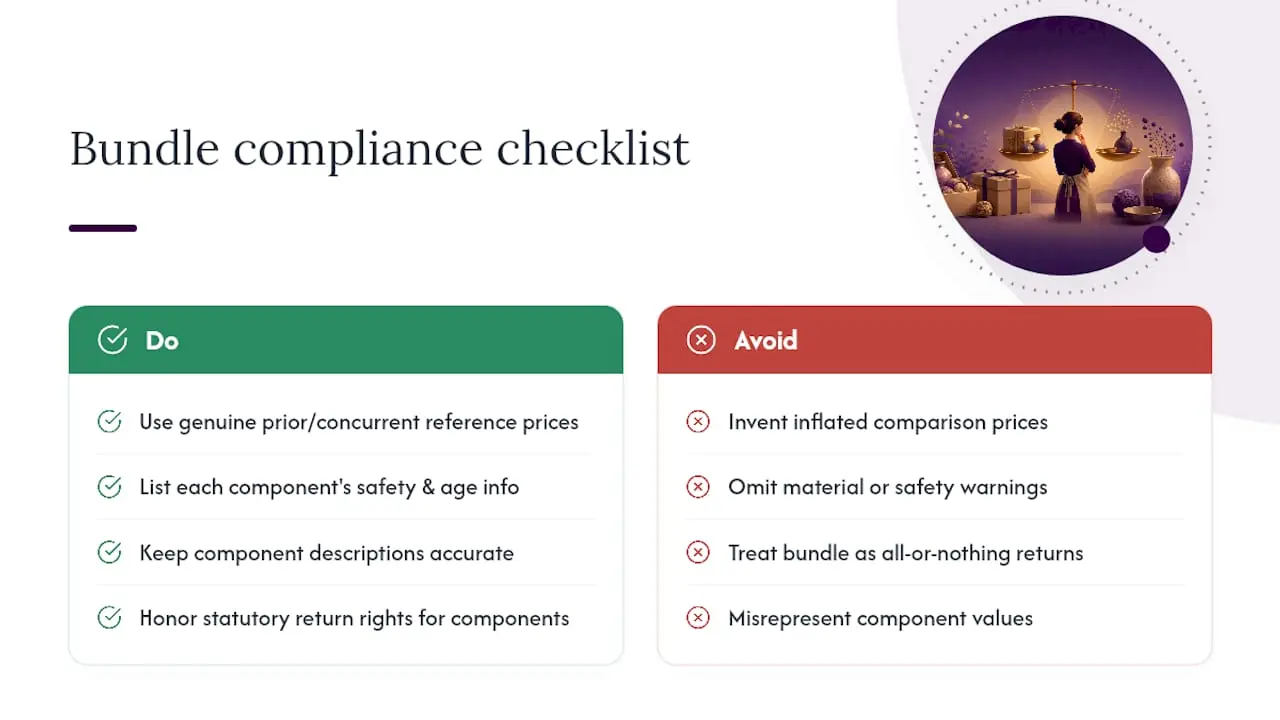
The comparison price in “Worth £X, yours for £Y” needs to reflect a genuine prior or concurrent selling price for the individual components, not an inflated figure invented to make the discount look bigger. Under UK consumer protection rules, a reference price that misrepresents the actual value of the components can constitute a misleading pricing practice, and marketplaces can and do act on seller complaints about this.
Component listing also matters for compliance, not just clarity. If a bundle includes items with different age restrictions, material warnings, or safety information (relevant for craft supplies involving adhesives, small parts, or sharp tools), each component’s own compliance information has to carry through to the bundle listing, not get dropped because it’s bundled. Buyers are still entitled to the same product information they’d get from a single listing.
Returns rights don’t change because an item was bought in a bundle either. A buyer’s statutory right to return a faulty or misdescribed component doesn’t disappear because it arrived as part of a set, and sellers who try to treat bundles as all-or-nothing on returns risk disputes they’d otherwise avoid. None of this should discourage bundling. It just means the same honesty standard that applies to a single listing’s price and description applies to every component inside a bundle too.
Author perspective — when I use bundles
My rule of thumb: bundle when curation adds something the buyer couldn’t easily assemble themselves, not when it’s a tidy way to offload stock. A themed card kit earns its bundle status; three unrelated toppers thrown together for a discount rarely does, and buyers can usually tell the difference. AOV matters, but not more than margin. A bundle that lifts revenue while quietly destroying contribution isn’t a win, it’s a slower-moving mistake.
— Rob
Publish your own bundles and mini-kits on Craftsuprint
Craftsuprint gives craft sellers a place to publish curated bundles alongside strong single listings, so you’re not forced to choose one format for your whole catalogue.
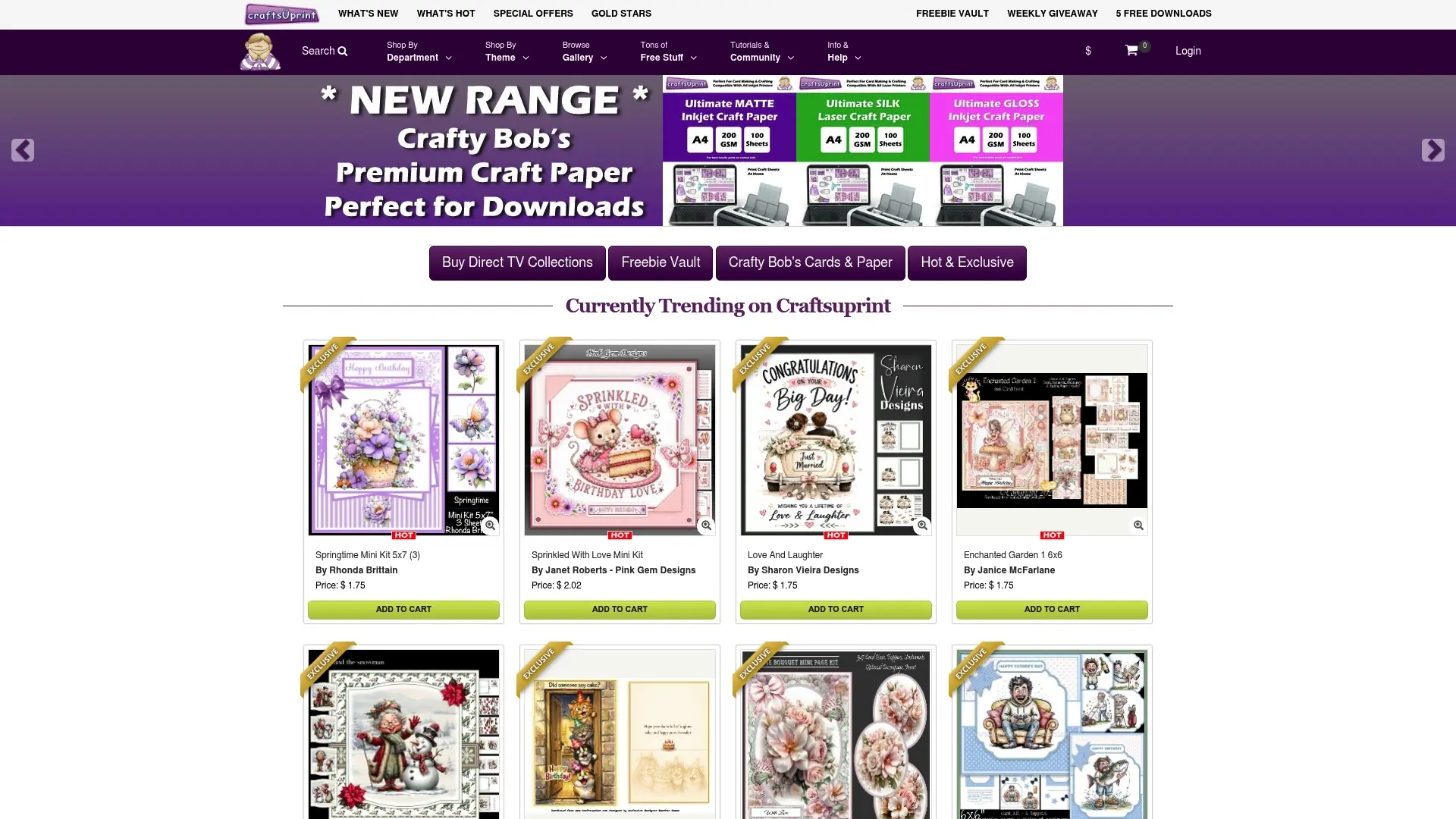
If you’re weighing up whether a themed kit or a single mini-kit fits your next release, browse the Create & Craft downloads catalogue for a sense of how other sellers structure their listings, or check the Create & Craft download page for details on how offers and promotions work on the platform. Once you’ve published a bundle, treat it as a live test rather than a finished product: track attach rate and returns for a few weeks and adjust the components before committing more stock to it. Start by listing your next themed set as a bundle on the Craftsuprint marketplace and measure how it performs against your existing singles.
Sources
- Product bundling (resources.rework)
- Dynamic bundling (Harvard Business School)
- Bundle pricing: how to boost AOV and margin in 2026 (Eightx)
FAQ
Do bundles sell better than single listings on marketplaces like Vinted?
Bundles often sell faster for buyers wanting convenience or a deal, but keeping singles listed too preserves the search visibility that bundle-only shops lose. The strongest approach mixes both rather than relying on one format alone.
Is it better to make multiple listings or one listing with quantity options?
Separate listings for genuinely different items give you better search visibility, since each one carries its own title and description. Use quantity options only when the item itself is identical, not when you’re grouping different products together.
Is it better to sell bundles on eBay?
Bundles on eBay work well for clearing related slow-moving stock and lifting order value, but pure bundling without any single-item listings can cut total sales by around 20% by losing single-item search traffic.
Is selling bundles worth it for a small craft business?
Yes, provided the discount is set from your actual contribution margin rather than a round number, and the components genuinely belong together. A well-curated bundle on a platform like Craftsuprint can lift average order value without the margin erosion that comes from arbitrary discounting.
What discount should I offer on a bundle?
A discount around 10% typically delivers the strongest contribution per order, balancing a meaningful attach-rate lift against margin retention better than steeper discounts do.